By Emma Fensom
For over half a century, voter competence has been a major concern of political science.[1] To some, this concern has been so great to say that the power of “irrational majorities” must be curtailed for democracies to ever produce ‘good’ policy.[2] What then makes a competent voter? Furthermore, is the concept of a ‘good’ voter compatible with the principles of democracy? To Kant, a just democracy exists where people are united under a “general will.”[3] However, he deemed only a certain class of people, “active citizens,” capable of being so.[4] In this essay, I argue that Kant’s distinction between passive and active citizens contradicts the very civil rights he purports to guarantee in a rightful state. Although a public capable of voting in accordance with the general will would likely produce fairer laws, it is unclear as to why Kant’s class of ‘active citizens’ are more likely to do so than their ‘passive’ counterparts. Moreover, it is unclear as to why active citizens would be incentivised to support universal independence for currently passive citizens. As such, Kant’s distinction was found to be arbitrary and, further, to ultimately lead to the continued oppression of women and the poor.
Central to Kant’s political philosophy is his “universal principle of right”, that “every action which by itself or by its maxim enables the freedom of each individual’s will to co-exist with the freedom of everyone else is right.”[5] Therefore, any action that can co-exist with the freedom of everyone else in accordance with universal law can be considered ‘right’ to Kant.[6] Notably, this principle is indifferent to the motives of those complying with its command, and instead solely concerns the legality and judicial character of actions.[7] This is important for two reasons. Firstly, it allows Kant to justify a transition from the state of nature, even where people can be found to act benevolently.[8] For, without laws, each person will do what is right and good according to them, and, as such, there will be no security against the possibility of violence.[9] Secondly, it allows for the state to coerce the behaviour of its members, as the only object of these political rights is the “external aspect of actions.”[10] Therefore, any law that ensures that each “individual receives what is their due,” can be considered a right, as long as it acts as a “hinderance to a hinderance of freedom.”[11] This represents the possibility for the “law of reciprocal coercion,” where all act in a manner to ensure the freedom of those around them.[12]
Thus, Kant advocated for a union of people under rightful laws.[13] As posited by Robert S. Taylor, the creation of the Kantian state would be through a gradual transition from an absolute monarchy to a democracy through the incremental cessation of legislative power to the people.[14] This state would consist of three powers: the ruling power of the legislator, the executive power of the sovereign, and the judicial power of the judge.[15] Furthermore, all citizens would have three inseparable rights: the lawful freedom to obey only the laws to which they have consented, the civil equality to not recognise anyone as their superior, and the civil independence to act within their rights and powers as a member of a commonwealth.[16]
Importantly, Kant rejected the notion of a democratic executive power, as this could lead to the majority of people deciding against the minority, in contradiction with principles of freedom and general will.[17] Instead, he advocated for a democratic legislature, united by the will of the people.[18] To Kant, under this general will, no law capable of doing injustice could be created.[19] This is because, needing to obey the law themselves, no citizen would create laws that would necessarily go against their own freedom.[20] However, in affirming this, Kant placed restrictions on those eligible to vote, discriminating between ‘active’ and ‘passive’ citizens.[21] To Kant, a person had to have “an independent position among the people” to be fit to vote.[22] Thus, where passive citizens are found to depend upon of the will of others, he found them unfit to influence and organise the state.[23]
A common critique of the distinction between passive and active citizens concerns its ambiguity. As argued by Kate Moran, where passive citizens are still expected to obey and be punishable under the law, it is contradictory to deny them political participation, especially where the difference in their treatment appears arbitrary and grounded in prejudice.[24] Following the examples provided by Kant, day-labours, barbers, travelling blacksmiths, women, and children are all passive citizens; however, tailors and craftsmen are not.[25] To Moran, it is necessarily unclear as to how these examples follow from Kant’s rationale that active citizens must be their “own master” and have “some property.”[26] For, a barber may have greater material wealth than a tailor, and, as such, may be less influenced by the views of his patrons in regard to voting.[27] Alternatively, others have interpreted this difference as a distinction between those who create their own opus and those who do not, an opus being a product of labour that is alienable from its creator.[28] For example, a wig maker creates wigs, whereas barbers only trim the hairs of others. As such, those who produce their own opus could be considered stakeholders in civil society, as they actively contribute to it, thereby earning the right to vote.[29] Despite this, Moran argues that this line of reasoning is refuted by Kant himself, where he claims that all individuals need their rights protected by civil society and, as such, are stakeholders in its existence and prosperity.[30] Furthermore, it is likely true that those who provide services, instead of creating their own opus, have a greater stake in the proper functioning of society, as their livelihoods depend directly on stable social relations.
Therefore, the only grounds for the distinction that remains is the concern that passive citizens will always vote in the interests of their protectors, thereby duplicating their protectors’ vote.[31] To Jacob Weinrib, a state of dependency affects a person’s capacity to vote for the general will, as dependents are likely compelled to vote in the interests of their superiors to protect their livelihoods.[32] For instance, where women historically depended on their husbands for income, they were likely influenced to vote in accordance to their husbands’ interests rather than those of greater society or even their own. Instead, Weinrib argues that the Kantian state would have a duty to create the conditions for passive citizens to become active.[33] For example, by providing economic support to prevent the dependency of the poor. Thus, where universal independence can eventually be established, all citizens would gain the capacity to be active members of society.
Despite this, Weinrib’s argument is likely overcome on the basis that it presumes an ideal account of political participation, where all active citizens will vote in accordance with the general will.[34] Where this cannot be guaranteed, it is unclear as to whether a state would ever secure universal independence. As such, where likely wealthy ‘active citizens’ may vote in their own interest, the conditions of poverty are perpetuated. Further, critiques such as that depriving women suffrage denies them of any hope of gaining independence likely still stand.[35] This is because it is regardless true that refusing a civil personality to women forces them into dependent marital relationships with men, thereby reaffirming their passivity.[36] This fact also remains true for the continuation of the cycle of poverty. Instead, as Moran accurately highlights, concerns over influenced votes can be defeated by a secret ballot, where dependent citizens need not fear the reprisal of their protectors.[37]
In conclusion, Kant’s distinction between passive and active citizens was found to be unnecessary and, furthermore, detrimental to the goal of universal independence. Although concerns in regard to voting capacity are valid with respect to ensuring just laws, Kant’s solution of denying the vote to those in positions of dependence fails where he cannot guarantee the ideal political participation of his active citizens. Instead, it is in the denial of suffrage that the conditions of dependency are perpetuated, thereby producing ‘incompetent voters.’ Further, in implementing a secret ballot, his concerns are likely overcome. Ultimately then, universal suffrage is required for Kant’s ‘just democracy.’
Emma is currently studying a Bachelor of Arts/Laws, with an extended major in Philosophy and minor in English Literature. She is interested in most areas of philosophy as well as Zen Buddhism and modernist literature.
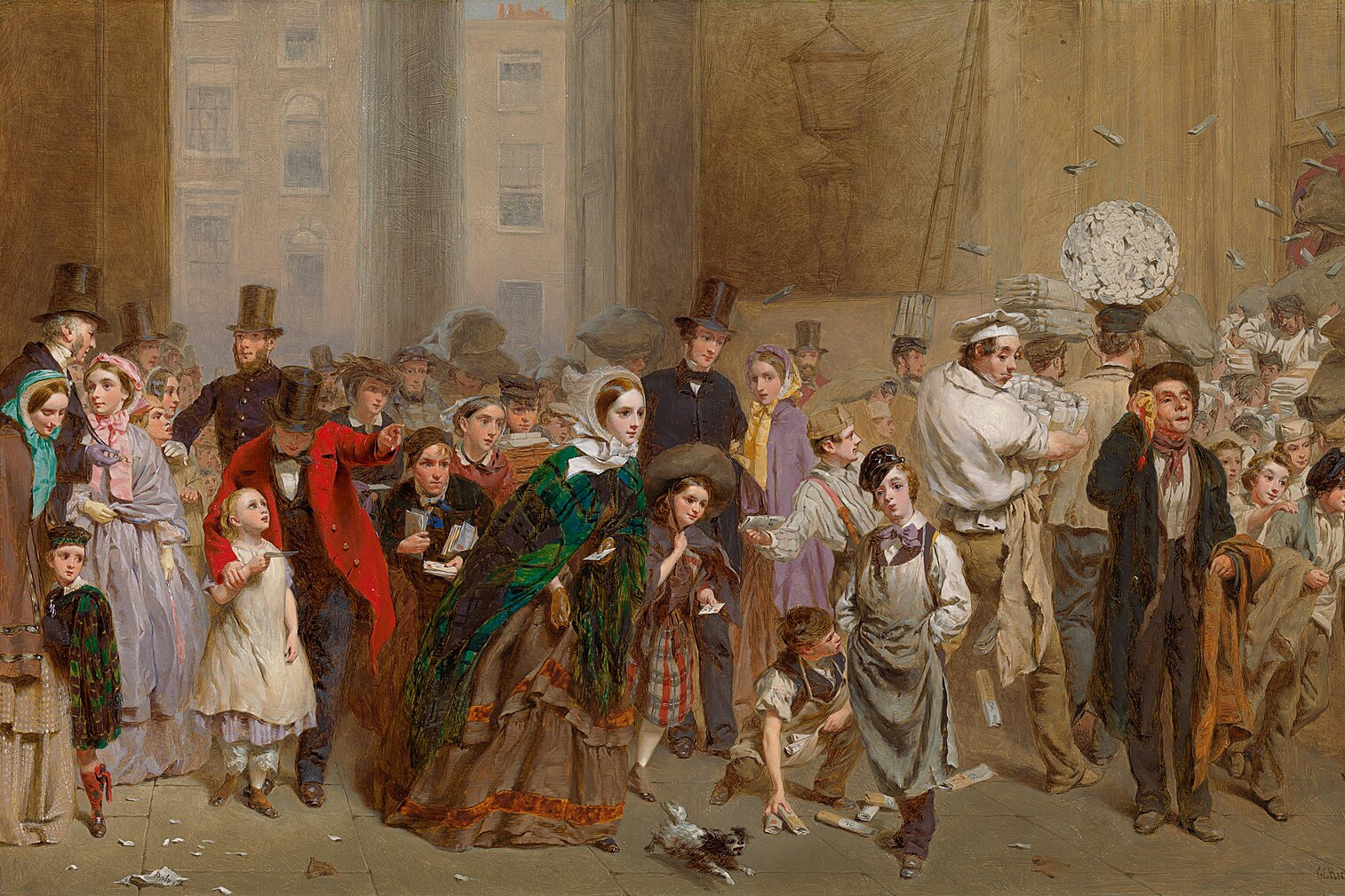
Featured image: The General Post Office, One Minute to Six by George Elgar Hicks (1860).
Bibliography
Scott Ashworth and Ethan Bueno de Mesquita, “Is Voter Competence Good for Voters?: Information, Rationality, and Democratic Performance,” American Political Science Review 108, no. 3(2014).
Immanuel Kant, Kant: Political Writings, trans. H. B. Nisbet (Cambridge: Cambridge University Press, 1991).
Loren Lomasky, “Swing and a Myth: A Review of Caplan’s The Myth of the Rational Voter,” Public Choice 135, no. 3/4(2008).
Susan Mendus, “Kant: “An Honest but Narrow-Minded Bourgeois”? in Kant’s Political Philosophy, ed. Howard Williams (Cardiff: University of Wales Press, 1992).
Kate Moran, “Kant on Travelling Blacksmiths and Passive Citizenship,” Kant-Studien 112, no. 1(2021).
Carole Pateman, The Sexual Contract (Cambridge: Polity Press, 1988).
Brain J. Shaw, “Rawls, Kant’s Doctrine of Right, and Global Distributive Justice,” The Journal of Politics 67, no. 1(2005).
Emmanuel Joseph Sieyès, The Essential Political Writings, ed.Oliver W. Lembcke and Florian Weber (Leiden: Koninklijke Brill NV, 2014).
Robert S. Taylor, “Democratic Transitions and the Progress of Absolutism in Kant’s Political Thought,” The Journal of Politics 68, no. 3(2006).
Jacob Weinrib, “Kant on Citizenship and Universal Independence,” Australian Journal of Legal Philosophy 33 (2008).
[1] Scott Ashworth and Ethan Bueno de Mesquita, “Is Voter Competence Good for Voters?: Information, Rationality, and Democratic Performance,” American Political Science Review 108, no. 3(2014): 565.
[2] Loren Lomasky, “Swing and a Myth: A Review of Caplan’s The Myth of the Rational Voter,” Public Choice 135, no. 3/4(2008): 469.
[3] Immanuel Kant, Kant: Political Writings, trans. H. B. Nisbet (Cambridge: Cambridge University Press, 1991), 138.
[4] Kant, Political Writings, 139.
[5] Kant, Political Writings, 133.
[6] Brain J. Shaw, “Rawls, Kant’s Doctrine of Right, and Global Distributive Justice,” The Journal of Politics 67, no. 1(2005): 233.
[7] Shaw, “Rawls, Kant’s Doctrine of Right, and Global Distributive Justice,” 233.
[8] Kant, Political Writings, 137.
[9] Kant, Political Writings, 137.
[10] Kant, Political Writings, 134.
[11] Kant, Political Writings, 134-5.
[12] Kant, Political Writings, 135.
[13] Kant, Political Writings, 136.
[14] Robert S. Taylor, “Democratic Transitions and the Progress of Absolutism in Kant’s Political Thought,” The Journal of Politics 68, no. 3(2006): 557.
[15] Kant, Political Writings, 138.
[16] Kant, Political Writings, 139.
[17] Kate Moran, “Kant on Travelling Blacksmiths and Passive Citizenship,” Kant-Studien 112, no. 1(2021): 122.
[18] Moran, “Kant on Travelling Blacksmiths and Passive Citizenship,” 122.
[19] Kant, Political Writings, 139.
[20] Kant, Political Writings, 139.
[21] Kant, Political Writings, 139.
[22] Kant, Political Writings, 139.
[23] Kant, Political Writings, 140.
[24] Moran, “Kant on Travelling Blacksmiths and Passive Citizenship,” 106.
[25] Kant, Political Writings, 139.
[26] Moran, “Kant on Travelling Blacksmiths and Passive Citizenship,” 106.
[27] Moran, “Kant on Travelling Blacksmiths and Passive Citizenship,” 110.
[28] Moran, “Kant on Travelling Blacksmiths and Passive Citizenship,” 109.
[29] Emmanuel Joseph Sieyès, The Essential Political Writings, ed.Oliver W. Lembcke and Florian Weber (Leiden: Koninklijke Brill NV, 2014), 127.
[30] Moran, “Kant on Travelling Blacksmiths and Passive Citizenship,” 112.
[31] Moran, “Kant on Travelling Blacksmiths and Passive Citizenship,” 112.
[32] Jacob Weinrib, “Kant on Citizenship and Universal Independence,” Australian Journal of Legal Philosophy 33 (2008): 11.
[33] Weinrib, “Kant on Citizenship and Universal Independence,” 17.
[34] Moran, “Kant on Citizenship and Universal Independence,” 114.
[35] Susan Mendus, “Kant: “An Honest but Narrow-Minded Bourgeois”? in Kant’s Political Philosophy, ed. Howard Williams (Cardiff: University of Wales Press, 1992): 174.
[36] Carole Pateman, The Sexual Contract (Cambridge: Polity Press, 1988), 169.
[37] Moran, “Kant on Citizenship and Universal Independence,” 113.

 EXORDIUM