By Andrew Millar
“The difference between this painting and the others the late Rembrandt painted is the difference between seeing and being seen. That is, in this picture he sees himself seeing whilst also being seen, and no doubt it was only in the Baroque period with its penchant for mirrors within mirrors […] that such a painting was possible. But it exists in our age, it sees for us” — Karl Ove Knausgård, My Struggle: Book 1
“A good painter is to paint two main things, namely man and the workings of man’s mind. The first is easy, the second difficult” — Leonardo da Vinci, Notebooks
Rembrandt Harmenszoon van Rijn’s (1606-1669) lifelong practice of self-portraiture throughout the seventeenth century was a project of self-documentation hitherto unobserved in the history of art, and few artists since have rivalled the continuity and temporal span of Rembrandt’s self-portraits.[1] More than any other subject Rembrandt painted, his self-portraits have produced a fecundity of discourse throughout the centuries so as to make the artist synonymous with the genre. Attendant to this discourse are a range of highly autobiographical, psychological interpretations of the self-portraits, pioneered by art historians like Jakob Rosenberg.[2] Alongside this psychologistic discourse, an equally fervent anti-psychological strain of criticism of Rembrandt emerged, with Hans-Joachim Raupp suggesting that Rembrandt’s self-portraiture was the by-product of a “carefully planned programme” and not any kind of penetrating self-analysis via painting.[3] In this essay I will argue that theories emphasising the historical and social circumstances surrounding the production of Rembrandt’s self-portraits need not be separated from psychological, philosophical interpretations. I will draw on phenomenological arguments from Emmanuel Levinas and Maurice Merleau-Ponty to position self-portraits as an “encounter” of seeing and visibility that discloses a subjective, psychological experience. From this framework, I argue that Rembrandt’s self-portraits provide us with an insight into the subjective act of seeing and the nature of vision, which is disclosed through an encounter with Rembrandt’s own face. I will position this analysis alongside three self-portraits from Rembrandt’s late period: Self-Portrait with Beret and Turned-Up Collar (1659) [Plate 1], Self-Portrait with Two Circles (c. 1665-9) [Plate 2], and Self-Portrait at the Age of 63 (1669) [Plate 3].
Both Volker Manuth and Ernst van de Wetering situate Rembrandt within a great Northern tradition of painting, a fact of which the painter himself would have been acutely aware.[4] The individualist, humanist ethos of the Renaissance that dominated the artistic idioms of the fifteenth and sixteenth centuries incorporated artists into this tradition as famosi (famous men), and by the sixteenth century, works like Giorgio Vasari’s (1511-1574) Lives of the Artists contained the first anthology of self-portraits by artists.[5] Furthermore, a collection of Dutch artists’ portraits published by Domenicus Lampsonius (1532-1599) in 1572 was of importance to Rembrandt in its championing of a specifically Northern artistic tradition, and Manuth points to Rembrandt’s sixteenth century attire in many of his self-portraits as evidence of his alignment with such a tradition.[6] Simultaneous to this inherited artistic legacy of the Renaissance, there existed a growing sub-culture of artistic connoisseurship in seventeenth century Netherlands which brought fame to artists and increased demand for their work, as well as demand for images of famous people, a group that some artists now belonged to.[7] Painterly subject was of secondary importance to art lovers, who exhibited a preference for the “magic” of a painter’s technique and style on the canvas; as such, the subject of any given painting served as merely the occasion for this display of mastery rather than the painting’s raison d’être.[8]
Rembrandt’s self-portrait’s fulfilled a dual function; they were both a demonstration of his technical painting mastery and style, and an image of the painter himself.[9] Luigi Lanzi (1732-1810) wrote of the Medici self-portrait gallery in 1782: “every portrait in the two rooms is a self-portrait of the painter, so in each painting one has a depiction of the artist and at the same time a depiction of his style.”[10] Rembrandt’s innovation with colour, light, and space (the glittering quality of his paintings in changing light from heavy layering and impasto) and his free handling of brushstrokes were part of this recognisable style that attracted art lovers to his work;[11] the recognisability of Rembrandt’s likeness was also established as early as 1639, most surely contributing to some demand for his self-portraiture.[12] Van de Wetering argues that Rembrandt’s early self-portraits as tronies[13] became an iconic element of his oeuvre, which may explain why more famous painters like Peter Paul Rubens (1577-1640) did not produce the same volume of self-portraits as Rembrandt, whose work was considered synonymous with the genre.[14]
As a further complication for psychological interpretations of Rembrandt’s self-portraits, the modern conception of selfhood rooted in Romantic-era ideology of the early-nineteenth century did not exist in seventeenth century Netherlands, and to impose such an interpretation risks anachronistic errors in Rembrandt scholarship.[15] While the Renaissance championed the human as the centre of the universe and “measure of all things,” the Romantic era precipitated an equally-significant egoistic shift of the “I” towards the “[hu]man of feeling,” who creates solely from within.[16] Even the term ‘self-portrait’ did not exist in the sixteenth century, with many of Rembrandt’s self-portraits dubbed “Rembrandt’s likeness done by himself” or some variant thereof.[17] van de Wetering cites the example of Nicolas Poussin’s (1594-1665) 1650 portrait of himself commissioned by Paul Fréart de Chantelou (1609-1694); no suitable painter could be found, so Poussin painted the portrait himself.[18] To van de Wetering, this suggests that there was no unique ontological significance bestowed upon a self-portrait at the time any more so than a standard portrait, in that it did not particularly matter whether Poussin painted the portrait or someone else did. Consequently, the overtly poetic and Romantic interpretations of Rembrandt’s self-portraiture advanced by critics like Rosenberg evince, for van de Wetering, a failure to historically situate Rembrandt’s artistic practice within an artistic tradition whereby no historical or social importance was bestowed upon an artist’s acts of self-portraiture; there was no special historical significance to the notion that Rembrandt should record his own likeness over any other.[19]
As thorough and compelling as these historical accounts of Rembrandt’s self-portraiture are however, none of these arguments refute the possibility of his self-portraits remaining open to a degree of psychological interpretation. Didier Maleuvre is critical of a disciplinary tendency within art history to favour the ‘scientific’ method of analysis, rooted solely in material/historical/social ‘facts’—we are asked to direct our focus to workshop production, the variegated economic trends of buying and selling pictures, and public tastes.[20] Maleuvre argues that this approach, when applied militantly, reduces every Rembrandt portrait to a set of historical abstractions – “market conditions, stylistic conventions, set programmes”[21] – which not only borders on fallacious as a ‘pure’ explanation of their origin, but also asks one to ignore the contextual circumstance of their creation; that the painter sat before himself and carefully, painstakingly produced a portrait over months of work and observation.[22] Put more simply: “Abstractions like ‘the market’ or ‘public taste’ do not make pictures. Men and women do.”[23] How then to reconcile the material conditions of Rembrandt’s self-portraiture with their unarguably personal nature?[24] I argue that Rembrandt’s self-portraits provide an insight into the subjective act of seeing and of visibility, disclosed through an encounter with the face of Rembrandt himself.
Maleuvre likens the experience of seeing a portrait to an “encounter” with another person’s face:[25] there is an initial distance, then the scene dissolves and we are met with a sense of aura, as though we are communing with the person depicted therein.[26] Renée van de Vall, upon confronting Rembrandt’s Self-Portrait with Two Circles (c. 1665-9) [Plate 2], had a similar revelation. This self-portrait (and his other late self-portraits) “teaches us something about seeing”; namely, that the manner in which Rembrandt paints his face articulates our own manner of seeing faces.[27] A general fuzziness sits around the face in this portrait, with the right side partially shaded in subtle chiaroscuro work, accentuated by thicker daubs of light tones on the upper cheek and around the other side of his face. Van de Vall argues that this shadowplay and haziness elicits the face to reveal itself in stages and yet all-at-once, much like how we gaze upon a real face; our eyes graze over a cheekbone, to the nostrils, to an eyebrow, perhaps meeting the eye then looking elsewhere, all the while retaining a wholistic image of the face in-toto.[28] To witness this portrait is to “encounter” the face of the Other, which van de Vall links to the work of Emmanuel Levinas and the ethicality of vision.
When we see a face, even a painted one, we can never reduce it to an object, or to thingly status; we are met with a claim on our attention and an obligation to recognise this Other, closer to being spoken-to or touched, rather than a pure act of vision which necessarily establishes a distance between objects in the world and ourselves.[29] Levinas stresses throughout his ethical philosophy the metaphorical nature of the face as a feeling of obligation to the Other rather than a merely “visually apprehensible surface.”[30] The face in this sense acts as a unique site of articulation, whereby vision, hearing, and touch are imbricated such that to look upon one’s face is already to enter into an ethical agreement of recognition. As Levinas writes: “The vision of the face is no more vision, but listening and word.”[31] Here, Levinas’s denigration of vision as pure ocularcentrism is an effort to acknowledge the ethical, discursive relationship between Self and Other that is disclosed in the sensible encounter with the face—something both engendered by and irreducible to pure vision. Extending Levinas’s (non)phenomenology of the face to the realm of painting, Maurice Merleau-Ponty’s aesthetic phenomenology of painting argues that to paint a face is to touch it, with hands and fingers and instruments, and mould an image that inextricably links touch with vision and seeing: “The painter ‘takes his body with him.’”[32] Whether in painting oneself or another, the painter must produce vision through touch, through the body, whereby the sensibility of vision is reproduced in the very physical acts of the hands and body with paintbrush and colour, and therefore the act of portraiture itself is a non-verbal discourse of sorts between touch and vision: a series of negotiations between the face of the Other and our reproduction and representation of them. This task must also be undertaken by the viewer of a painting, and in this way, Rembrandt’s self-portraits solicit a performance from the beholder as an ethical articulation of the visuality of faces and of seeing itself in reconstructing Rembrandt’s face from the streaks and daubs of paint on a canvas; we ourselves both embody the touch and see the visible in recreating the face.[33]
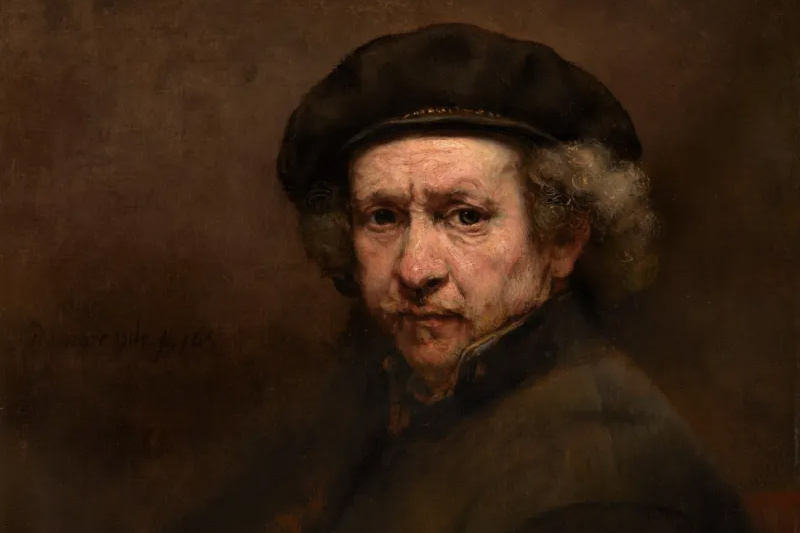
This obligation demanded of our sight is supported by what Maleuvre argues was the social milieu of the fluid, upwardly mobile mercantile Dutch society in which Rembrandt lived; chiefly, that one’s identity was contingent on the attention and recognition of others.[34] Maleuvre links Rembrandt’s self-portraits to the idea of identity as a “fungible asset” in this particular epoch; gone are the days when identity was an immutable category assigned-at-birth to peasants and noblemen.[35] This newly-mercantile society provided a fraught ground on which one’s social and economic standing could both rise and fall within an intensely social world. This uncertain position of social identity, one dependent on recognition, is mirrored in the expressivity of Rembrandt’s face in his late self-portraits, particularly Self-Portrait with Beret and Turned-Up Collar (1659) [Plate 1]. Rembrandt turns over his left shoulder to meet the viewer’s gaze, with most of the light falling over his face and eyes. The brushwork deftly blends thick, daubed impasto sections with finer, more finished patches alternating across his face to evoke the hollowed-out jowls of his cheeks, the folds under the eyes, the crinkle of weary lines above the eyebrows. We are obliged to recreate the face in real-time as Rembrandt did, following the tactility and movement of the brushstrokes, the paint tapering out to his nose and layered so thick that his face appears to protrude out of the canvas itself into space.[36] Darkness falls around Rembrandt’s eyes, which are undoubtedly the centrepiece of the portrait; the light reflecting from them appears almost to originate from within. The expression is ambiguous, but decidedly morose, as though threatening at any moment to break into a grimace or a frown. The 1659 self-portrait was one of the first Rembrandt painted after creditors seized most of his furniture; his social standing around Amsterdam was beginning to decline and would continue to do so throughout the last decade of his life.[37] What, if nothing else, is this portrait other than an act of acknowledgement and recognition of himself in the wake of an identity in decline? To meet that human face, his own, on ethical terms? Though we could not possibly assign a definitive state of mind to Rembrandt from his portrait and biographical circumstances, his very act of self-portraiture is a call for recognition, where the face of the Other-as-himself beckons forth as an ethical obligation to consider it, to recognise it as someone: as Rembrandt.
This recognition is not only a call to others, but a call to oneself on the part of Rembrandt. As Merleau-Ponty notes in “Eye and Mind”: “The enigma is that my body simultaneously sees and is seen […] It sees itself seeing; it touches itself touching; it is visible and sensitive for itself.”[38] The painter attempts to “make us see the visible”[39] as that which escapes regular sight, and for Rembrandt this is his own image. Rembrandt, sitting before the mirror to paint his self-portrait, cannot directly see his own seeing, and yet this is the paradox and the very telos of the self-portrait:[40] the mirror “changes myself into another, and another into myself.”[41] Here, Levinas’s ethicality of the face becomes mediated by the use of mirrors in self-portraiture: to see and paint the image of oneself in the mirror is to assume the role of the Other, and yet conversely the Other becomes Self. This is not an absorption or appropriation of the Other, but rather a phenomenological disclosure of the ambiguity expressed in an encounter with the face, and the way in which self-portraiture stages this complex situation of a body both “visible and sensitive for itself” in the same way we may regard the Other as such. To paint his own portrait locates Rembrandt in a liminal space between painter and subject by the very definition of the nature of seeing one’s own seeing; to see oneself and to see the seeing of oneself. In Self-Portrait at the Age of 63 (1669) [Plate 3], painted only a few months before his death,[42] we encounter a Rembrandt still reckoning with the changing nature of himself and the irreducibly perspectival nature of his own seeing; many adjustments were made to the painting, including the removal of a paintbrush in his hand and a white cap on his head.[43] In fact, all three self-portraits underwent many such changes until their completion,[44] indicating that the notion of a “carefully planned programme” argued by Raupp was far from certain each time Rembrandt sat before the easel to create his own image from the mirror. To see himself seeing, to make the visible visible, was no mere reduction to programmes or public tastes, but a constant process of change and alteration in attempt to capture his own likeness from the mirror.
Maleuvre argues that likeness itself in portraiture goes beyond simple appearance; it is a model of comparison.[45] Someone cannot look like themselves—this would be a tautology. Rather, a person looks like some particular image of themselves that has been mentally drawn by others, thus shifting the concept of likeness from the purely personal to an interpersonal, social act of another’s creative witnessing.[46] This notion is complicated by self-portraiture, for Rembrandt witnesses his own likeness – he is seeing himself seeing – and by virtue of the fact that likeness is a necessarily social and intersubjective concept, his self-portraits are a complex navigation between the personal and interpersonal to creatively imagine his own likeness throughout his life. In this way, his self-portraits are a construction of a particular kind of subjectivity, and imply an awareness of self that is both personal and intersubjective. To return to Merleau-Ponty, “the mirror changes myself into another and another into myself,”[47] and thereby Rembrandt’s self-portraits constitute himself as both an individual and a social agent in the world. The face of Rembrandt, both freely given and re-produced in his self-portraiture, complicates Levinas’s assertion that the face is “neither seen nor touched,”[48] for the ethical revelation of recognition disclosed in Rembrandt’s paintings are the result of a discursive relationship between the vision and tactility of the face itself.
Though the formal qualities of Rembrandt’s manipulation of colour and light – the erratic thickness and streaks of his brushstrokes densely layering the canvas with both movement and tactility – situate his self-portraiture practice within an art historical tradition of which Rembrandt was clearly aware, the self-portraits are equally in conversation with his own image and his role in creating it.[49] It is for this reason that Rembrandt continually modified his self-portraits throughout their construction, and it is also for this reason that we recognise Rembrandt throughout them: because he recognised himself. This is not a strictly visual sense of recognition; Rembrandt was, after all, an immensely skilled craftsman who was able to both visually recognise and reproduce any number of minute features in a painting. Rather, it is a recognition with an ethical dimension: “It is the face; its revelation is speech.”[50] Levinas’s metaphorical conception of the face and vision as a discursive site whereby we recognise and acknowledge the other may be better conceived as a “metaphor for a vision that does not contain, does not envelop, the otherness of the face,” and instead seeks only to acknowledge and to recognise.[51] One need only look to the 1669 Self-Portrait (Plate 3) and compare it to the 1659 Self-Portrait (Plate 1) for evidence. His wrinkles have deepened by 1669, with finer, streaked brushstrokes to the left side of his face illumined in light, moving over to heavy impasto on his nose, under his eyes, and to the right of his face receding into shadow, with remarkably fine modulation of colour with half-tones to evoke the sagging downward lines of his face brought out by chiaroscuro. His hair, though still long, is less bewildered, and has turned almost white, haloed by the beret and the circular patch of light in the background around his head. And yet, the same eyes, unchanged, gaze out at the viewer, reflecting the very same light from the 1659 Self-Portrait, light that appears to emanate from within. The eyes, caught in the moment of seeing, reflect back, reflect inward; they have not aged; they continue to see, to be seen; to see Rembrandt and for him to see himself. They see for us.
Rembrandt’s self-portraiture has long been a site of variegated discourse, with his moody, evocative self-portraits acting as the nexus between stridently psychological and anti-psychological schools of interpretation. Art historians like van de Wetering emphasise the historical context of their production; a growing connoisseurship of art and a demand for images of celebrity figures, as well as an awareness of a Northern artistic tradition, were all pertinent factors for Rembrandt in painting his own image over the decades. I have argued that these material conditions are not incommensurate with a psychological interpretation of Rembrandt’s self-portraits as phenomenological acts of self-recognition; to see himself seeing, and to create his own likeness. Both we and Rembrandt encounter and recreate his face, both recognisable and Other, in mutually constructive acts that endow subjectivity.
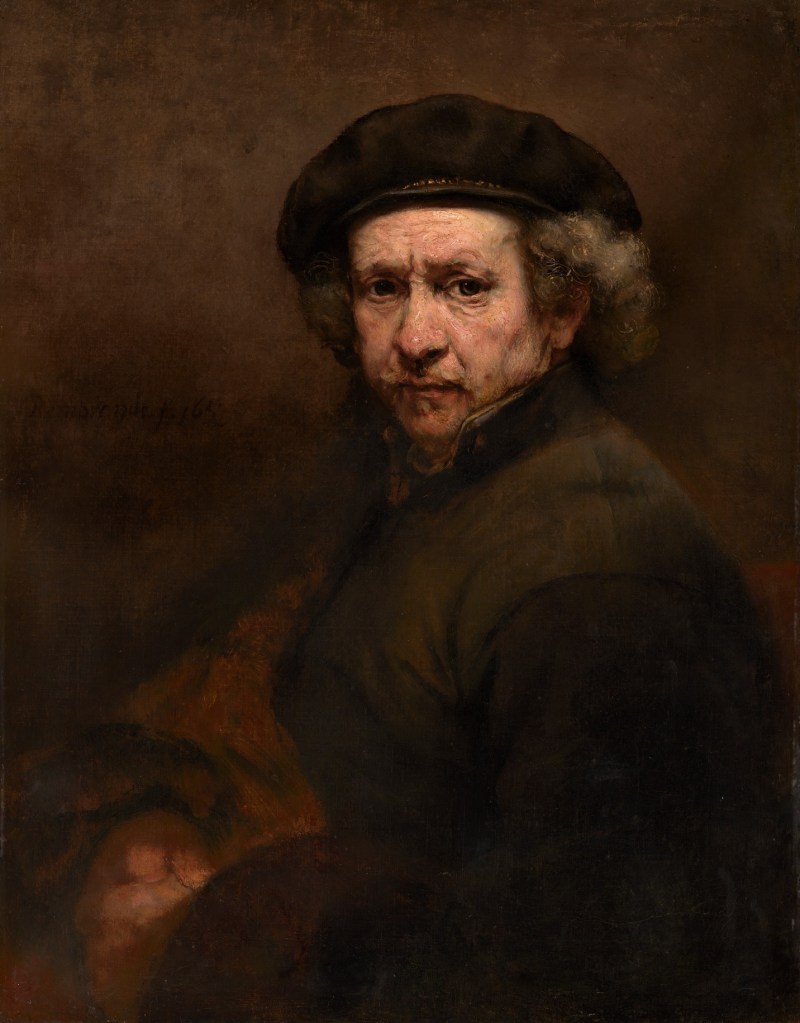
Plate 1 Rembrandt, Self Portrait with Beret and Turned-Up Collar, 1659, oil on canvas, 84.4 x 66 cm, Washington National Gallery of Art, Andrew W. Mellon Collection, Washington.

Plate 2 Rembrandt, Self Portrait with Two Circles, 1663, oil on canvas, 114.3 x 94 cm, Kenwood House, London.
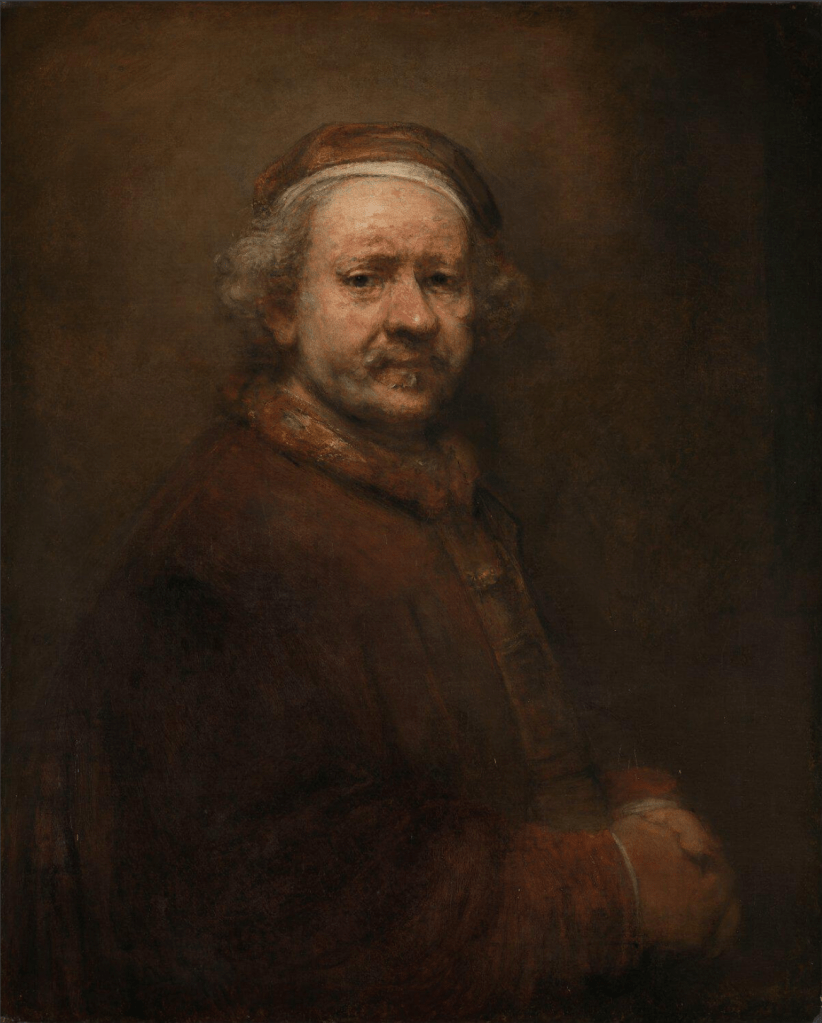
Plate 3 Rembrandt, Self Portrait at the Age of 63, 1669, oil on canvas, 86 x 70.5 cm, National Gallery, London.
Andrew Millar is a recent UQ Honours graduate in English Literature. His Honours thesis was on postmodern literature, historiography, and the Holocaust. He is primarily interested in postmodernism, continental philosophy (in particular phenomenology and post-phenomenology), and the intersections between literature and philosophy. He is also passionate about art history, and he hopes to pursue his PhD next year on a topic that can accommodate these different interests under one project.
Featured image: Self Portrait with Beret and Turned-Up Collar by Rembrandt Harmenszoon van Rijn (1659).
Bibliography
Buijsen, Edwin, Peter Schatborn, and Ben Broos. “Catalogue.” In Rembrandt By Himself, edited by Christopher White and Quentin Buvelot, 84-232. New Haven: Yale University Press, 1999.
da Vinci, Leonardo. Notebooks. Translated by Irma Richter. London: Oxford World’s Classics, 1980.
Knausgård, Karl Ove. My Struggle: Book 1. Translated by Don Bartlett. London: Vintage, 2013.
Levin, David Michael. The Philosopher’s Gaze: Modernity in the Shadow of Enlightenment. Los Angeles: University of California Press, 1999.
Levinas, Emmanuel. Totality and Infinity: An Essay on Exteriority. Translated by Alphonso Lingis. Pittsburgh: Duquesne University Press, 1969.
Manuth, Volker. “Rembrandt and the Artist’s Self-Portrait: Tradition and Reception.” In Rembrandt By Himself, edited by Christopher White and Quentin Buvelot, 38-58. New Haven: Yale University Press, 1999.
Maleuvre, Didier. “Rembrandt, or The Portrait as Encounter.” In Imaging Identity: Media, Memory, and Portraiture in the Digital Age, edited by Melinda Hinkson, 15-36. Canberra: ANU Press, 2016.
Merleau-Ponty, Maurice. “Eye and Mind.” Translated by Carleton Dallery. In The Primacy of Perception, edited by John Wild, 159-93. Evanston: Northwestern University Press, 1964.
Rosenberg, Jakob. Rembrandt: Life and Work. London: Phaidon, 1948.
Silverman, Hugh J. “Art and Aesthetics.” In Merleau-Ponty: Key Concepts, edited by Rosalyn Diprose and Jack Reynolds, 95-111. Stocksfield: Acumen Publishing, 2008.
Suthor, Nicola. Rembrandt’s Roughness. New Jersey: Princeton University Press, 2018.
van de Vall, Renée. “Touching the Face: The Ethics of Visuality Between Levinas and a Rembrandt Self-Portrait.” In Compelling Visuality: The Work of Art In and Out of History, edited by Claire Farago and Robert Zwijnberg, 93-111. Minneapolis: University of Minnesota Press, 2003.
van de Wetering, Ernst. Rembrandt: The Painter at Work. Amsterdam: Amsterdam University Press, 1997.
—. “The Multiple Functions of Rembrandt’s Self-Portraits.” In Rembrandt By Himself, edited by Christopher White and Quentin Buvelot, 8-38. New Haven: Yale University Press, 1999.
[1] Ernst van de Wetering, “The Multiple Functions of Rembrandt’s Self-Portraits,” in Rembrandt By Himself, eds. Christopher White and Quentin Buvelot (New Haven: Yale University Press, 1999), 10.
[2] Jakob Rosenberg, Rembrandt: Life and Work (London: Phaidon, 1948), 37.
[3] Ernst van de Wetering, “The Multiple Functions of Rembrandt’s Self-Portraits,” 28.
[4] Volker Manuth, “Rembrandt and the Artist’s Self-Portrait: Tradition and Reception,” in Rembrandt By Himself, eds. Christopher White and Quentin Buvelot (New Haven: Yale University Press, 1999), 40.
[5] Volker Manuth, “Rembrandt and the Artist’s Self-Portrait: Tradition and Reception,” 42.
[6] Volker Manuth, “Rembrandt and the Artist’s Self-Portrait: Tradition and Reception,” 43.
[7] Ernst van de Wetering, “The Multiple Functions of Rembrandt’s Self-Portraits,” 28.
[8] Ernst van de Wetering, “The Multiple Functions of Rembrandt’s Self-Portraits,” 25.
[9] Ernst van de Wetering, “The Multiple Functions of Rembrandt’s Self-Portraits,” 31.
[10] Ernst van de Wetering, “The Multiple Functions of Rembrandt’s Self-Portraits,” 30.
[11] Ernst van de Wetering, “The Multiple Functions of Rembrandt’s Self-Portraits,” 35.
[12] Volker Manuth, “Rembrandt and the Artist’s Self-Portrait: Tradition and Reception,” 48.
[13] A type of artwork common in the Dutch Golden Age that depicts an exaggerated facial expression.
[14] Ernst van de Wetering, “The Multiple Functions of Rembrandt’s Self-Portraits,” 36.
[15] Ernst van de Wetering, “The Multiple Functions of Rembrandt’s Self-Portraits,” 18.
[16] Ernst van de Wetering, “The Multiple Functions of Rembrandt’s Self-Portraits,” 18.
[17] Ernst van de Wetering, “The Multiple Functions of Rembrandt’s Self-Portraits,” 17.
[18] Ernst van de Wetering, “The Multiple Functions of Rembrandt’s Self-Portraits,” 17.
[19] Ernst van de Wetering, “The Multiple Functions of Rembrandt’s Self-Portraits,” 19.
[20] Didier Maleuvre, “Rembrandt, or The Portrait as Encounter,” in Imaging Identity: Media, Memory, and Portraiture in the Digital Age, ed. Melinda Hinkson (Canberra: ANU Press, 2016), 18.
[21] Didier Maleuvre, “Rembrandt, or The Portrait as Encounter,” 18.
[22] Didier Maleuvre, “Rembrandt, or The Portrait as Encounter,” 18.
[23] Didier Maleuvre, “Rembrandt, or The Portrait as Encounter,” 18.
[24] That is, Rembrandt sat in front of his own image for months each time he painted his portrait, which Maleuvre argues is an indisputably personal act of self-recognition and engagement, even if there were social and economic factors of seventeenth century Netherlands galvanising his production of self-portraits.
[25] It should be noted that much of the analysis that follows is contingent on a model of portraiture that follows pre-Impressionist conventions where a face is depicted reasonably clearly under the guise of some pretence at realism.
[26] Didier Maleuvre, “Rembrandt, or The Portrait as Encounter,” 17.
[27] Renée van de Vall, “Touching the Face: The Ethics of Visuality Between Levinas and a Rembrandt Self-Portrait,” in Compelling Visuality: The Work of Art In and Out of History, eds. Claire Farago and Robert Zwijnberg (Minneapolis: University of Minnesota Press, 2003), 94-5.
[28] Renée van de Vall, “Touching the Face: The Ethics of Visuality Between Levinas and a Rembrandt Self-Portrait,” 98.
[29] Renée van de Vall, “Touching the Face: The Ethics of Visuality Between Levinas and a Rembrandt Self-Portrait,” 102.
[30] Renée van de Vall, “Touching the Face: The Ethics of Visuality Between Levinas and a Rembrandt Self-Portrait,” 100.
[31] David Michael Levin, The Philosopher’s Gaze: Modernity in the Shadow of Enlightenment (Los Angeles: University of California Press, 1999), 273.
[32] Maurice Merleau-Ponty, “Eye and Mind,” trans. Carleton Dallery, in The Primacy of Perception, ed. John Wild (Evanston: Northwestern University Press, 1964), 162.
[33] Renée van de Vall, “Touching the Face: The Ethics of Visuality Between Levinas and a Rembrandt Self-Portrait,” 103.
[34] Didier Maleuvre, “Rembrandt, or The Portrait as Encounter,” 25.
[35] Didier Maleuvre, “Rembrandt, or The Portrait as Encounter,” 22.
[36] Ernst Van de Wetering, Rembrandt: The Painter at Work (Amsterdam: Amsterdam University Press, 1997), 279.
[37] Didier Maleuvre, “Rembrandt, or The Portrait as Encounter,” 26.
[38] Maurice Merleau-Ponty, “Eye and Mind,” 162.
[39] Maurice Merleau-Ponty, “Eye and Mind,” 162.
[40] Hugh J. Silverman, “Art and Aesthetics,” in Merleau-Ponty: Key Concepts, eds. Rosalyn Diprose and Jack Reynolds (Stocksfield: Acumen Publishing, 2008), 107.
[41] Maurice Merleau-Ponty, “Eye and Mind,” 168.
[42] Edwin Buijsen, Peter Schatborn, and Ben Broos, “Catalogue,” in Rembrandt By Himself, eds. Christopher White and Quentin Buvelot (New Haven: Yale University Press, 1999), 223.
[43] Edwin Buijsen, Peter Schatborn, and Ben Broos, “Catalogue,” 224.
[44] Edwin Buijsen, Peter Schatborn, and Ben Broos, “Catalogue,” 200-24.
[45] Didier Maleuvre, “Rembrandt, or The Portrait as Encounter,” 16.
[46] Didier Maleuvre, “Rembrandt, or The Portrait as Encounter,” 16.
[47] Maurice Merleau-Ponty, “Eye and Mind,” 162.
[48] Emmanuel Levinas, Totality and Infinity: An Essay on Exteriority, trans. Alphonso Lingis (Pittsburgh: Duquesne University Press, 1969), 194.
[49] Didier Maleuvre, “Rembrandt, or The Portrait as Encounter,” 27.
[50] Emmanuel Levinas, Totality and Infinity, 193.
[51] Renée van de Vall, “Touching the Face: The Ethics of Visuality Between Levinas and a Rembrandt Self-Portrait,” 102.

 EXORDIUM