Kant and the Void: Towards a Post-Critical Ontology

Immanuel Kant argues in the Critique of Pure Reason that the formal possibility for synthetic a priori knowledge depends upon the distinction between appearances and things-in-themselves. In this essay, it will be argued that although Kant successfully resolves the problems implicit in the categories of classical metaphysics, his solution unnecessarily limits thought to appearance. To counter his claim, set theory will be put forward as a synthetic a priori knowledge irreducible to appearance.

Environment: Wilderness, Home, Commodity

By taking a reflective approach to her relationship with the environment, Mira Gibson intersects William Cronon’s article ‘The Trouble of Wilderness’ (1996) with Steven Vogel’s paper ‘Marx and Alienation from Nature’ (1988) to explore her relationship with the environment. Through this reflection, she investigates what she means by ‘environment’ and the implications of this on her ethical life. Then, she situates the possibility for environmental change within the social networks of labour.

Capital Punishment as a Categorical Contradiction of our Duty to Respect Other Humans

In this paper I argue that Immanuel Kant’s positions on the death penalty as a justified form of punishment and on universally owed respect are incompatible, both in practice during Kant’s lifetime, and conceptually. This contradiction is identified between concepts presented in two parts of Kant’s The Metaphysics of Morals, and while both sections have different focus areas within the broader field of ethics, their respective subject matter is intended to occur within the same universal system of philosophy. As such, identifying this incongruency in Kant’s system suggests that his concepts of either punishment or respect may not be adequately justified.

Kristeva and Lacan: The Maternal Semiotic and the Ethics of Subjectivity

This essay concerns Kristeva’s philosophical debt to Lacan. I argue that Kristeva’s contribution to psychoanalysis does not involve the wholesale rejection of Lacanian theory. I place specific emphasis on her notion of the maternal semiotic and relate it to Lacan’s notion of the symbolic. I then investigate how this forms the basis for Kristeva’s ideas related to feminist ethics, before addressing criticisms directed towards her purported essentialism.

Elegy for the Aura

By reading Benjamin alongside Proust, this essay argues that the loss of the aura has been of aesthetic detriment. Despite Benjamin’s exhortation, the political potential left in the aura’s absence has gone unrealised. The wonder of auratic experience that Proust describes is lost without a worthwhile replacement, and our relationship to art is less than it could be.

To Laugh at Scientists: Nietzschean Tragic Culture in the Contemporary World

Nietzsche’s aesthetic philosophy in The Birth of Tragedy—though timelessly incisive—is restricted by the passionate and romantic inclinations evident in his early works. This paper reconstructs the origin, function and demise of Nietzschean tragic culture under the hegemony of Socratism, before revealing self-imposed limitations within his metaphysics of art, and adjusting his call for a renewal of tragic culture to be applied to the ostensibly endless world of multimodal expression we exist within today.

Choices inside Patriarchy; Patriarchy inside Choices

This essay delves into the complexities of mainstream modern feminism, specifically choice feminism, by conceptualising it as a reaction to the sex wars of the 1970s. I contrast what it means to be empowered as a woman with what it means to be liberated and explore how choice feminism inadvertently quashes the vital interaction and critical discussion generated by opposing feminist viewpoints such as these two.

Between Mirrors and the World: A Critique of Plato’s Aesthetics

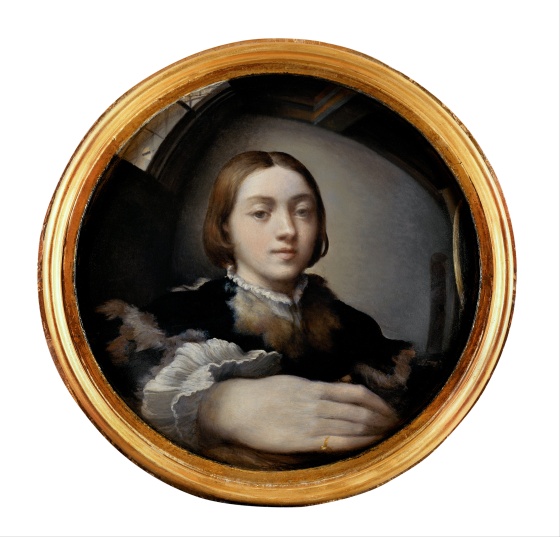
In this essay, I explore Plato’s critique of art as mere imitation from The Republic. I explicate Plato’s argument, before turning to a defence of the arts by critiquing Plato’s conception of art as mimesis through Parmigianino’s painting ‘Self-Portrait in a Convex Mirror,’ and Josh Ashbery’s poem of the same name. The essay combines a traditional philosophical essay with a more abstract form of critique, drawing on visual art and poetic analysis to argue against Plato’s metaphysical claims about the truthfulness of art.