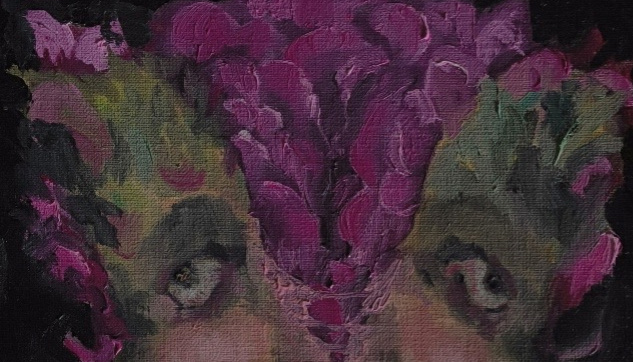
By Jordyn Garvie
Content warning: This paper has mentions of suicide. A further notice appears at the relevant passage. Take care.
In my experience as a visual artist, making art changes how I relate to myself. Sometimes this change involves learning to synthesise my reasoning with my sensory faculties. At other times, it disturbs the distinction between myself and my art. These experiences raise the questions that will guide this essay, which are, primarily: What about me changes when I make art? Where in the artistic process does this change occur, and to what extent does it last?
To clarify what changes in my relationship to myself, I begin with the Frankfurt School’s critique of instrumental rationality. This provides a way of describing a calculative relationship to myself and the world that artistic practice may interrupt. Their understanding of the term originates in Max Weber’s definition of instrumental action[1] among the four types of social action, which he formulates as:
expectations as to the behaviour of objects in the environment and of other human beings; these expectations are used as “conditions” or “means” for the attainment of the actor’s own rationally pursued and calculated ends.[2]
In other words, instrumental action involves treating circumstances and other people as means or conditions for achieving a chosen end. This way of reasoning is not necessarily objectionable: making art itself requires practical decisions about materials, techniques, and time. The problem, as identified by the Frankfurt School, arises when the means–ends relationship becomes the dominant way of relating to ourselves and the world.[3] From this perspective, experiences, other people, and through this, who you are risk being understood primarily in terms of their usefulness. The change that interests me concerns whether making art can loosen this calculative relationship to myself, and whether that interruption alters how I subsequently feel, think, and act.
I explore these questions through Friedrich Schiller’s account of the play drive and Friedrich Nietzsche’s account of the Dionysian. These concepts illuminate different aspects of my artistic experience: Schiller helps me describe a reconciliation of sensibility and reason, while Nietzsche helps me describe moments when the distinction between myself and the work becomes less secure. Together, they provide a way to consider both what changes during artistic practice and how long those changes might last.
This essay is primarily a philosophical reflection on my own artistic practice rather than an attempt to establish a universal account of art’s effects. I first outline Schiller’s play drive and Nietzsche’s Dionysian, then use them to interpret the making of one painting. I argue that the temporary disruption of selfhood described through the Dionysian need not conflict with the more sustained development suggested by Schiller’s aesthetic education. An experience may be temporary while its consequences endure.
The Play Drive
Schiller’s argument for the play drive begins with his account of how modern civilisation has torn apart the unity of human nature. The growth of specialised knowledge and the complex machinery of the modern state have sharpened divisions between sensibility and reason.[4] The result is that individuals become fragments:
Everlastingly chained to a single little fragment of the Whole, man himself develops into nothing but a fragment…instead of putting the stamp of humanity upon his own nature, he becomes nothing more than the imprint of his occupation or of his specialised knowledge.[5]
The individual becomes a “fragment” when the demands of a particular role cultivate one part of their nature at the expense of others. This provides a point of connection with the problem of instrumental rationality outlined above: When we understand ourselves primarily through our usefulness for a given purpose, the development of our other capacities can become secondary. Paul Guyer notes that while Schiller treats fragmentation as a particularly modern problem, it also implies that this is an ever-present worry for human nature, since the ‘person’ and the ‘condition’ are constants within it.[6] Schiller’s diagnosis describes a condition produced by instrumental rationality, as it reduces reason to an ability to find efficient means to arbitrarily given ends, which essentially splits the means from the ends.[7] This fragmentation is a concern for Schiller because it stands in the way of moral and political freedom, which requires the wholeness of a self in whom sensibility and reason are reconciled.[8]
To analyse this condition Schiller offers his theory of the drives: the sense drive and the formal drive. The sense drive is rooted in our physical existence and on its own, it dissolves personality into flux and need. The formal drive is rooted in our rational nature. It “provides laws for judgment” in cognition, and on its own it begins to anticipate sensation and crowd out experience. When left to themselves, each drive threatens the other and destroys wholeness.[9]
In Letters 14-15 Schiller introduces the play drive as a third impulse that mediates between the sensuous and formal drives by reconciling change with identity in the experience of beauty as “living form.”[10] In this state, our nature is “constrained neither physically nor morally and yet…active in both ways,” so that the determinations of sense and reason reciprocally limit one another and yield what Schiller calls aesthetic freedom.[11] This free accord of drives makes us whole, in whom sensibility and reason are both fully alive: “Man only plays when he is in the fullest sense of the word a human being, and he is only fully a human being when he plays.”[12] Schiller builds model where exercising the play drive is a necessary and sufficient condition for a full realisation of humanness. Aesthetic education restores the capacity to feel and think together, making it possible to act from duty without suppressing inclination, and thus to inhabit a free self. Guyer reads this as Schiller’s claim that aesthetic education is a precondition for moral autonomy: by reconciling sensibility and reason, aesthetic experience changes the structure of the self in ways required for successful moral and practical judgment.[13] This in turn, allows schiller’s account of the play drive to provide the conditions for the possibility of a lasting transformation of the self.[14]
The Dionysian
In The Birth of Tragedy (1872), Nietzsche is concerned with how existence can be justified once rational explanation alone proves insufficient. I will draw from interpretations made by Raymond Geuss to inform my outline of Nietzsche’s argument. For Nietzsche, the problem of how we affirm our existence is answered by the Dionysian and Apollonian. Put briefly, the Apollonian embodies individuated appearance through form and clarity, while the Dionysian presents a collective frenzy where the individual is dissolved through intoxicated ecstasy.[15] For my argument, I will focus on the instances where the Dionysian dominates an artistic process. The following extract provides insight into how Nietzsche outlines the relationship between the individual and the Dionysian: “Collapse…the principium individuationis, and we shall gain an insight into the being of the Dionysian.”[16] Here, the Dionysian can be seen as a response to the burden of individuation where the isolated self is suspended and briefly returned to unity with others and nature. In the following extract, we see how the Dionysian suspension of the isolated self reveals a mode of experience that Socratic rationality cannot account for.
A profound illusion which first came to the world in the person of Socrates, the imperturbable belief that, by means of the clue of causality, thinking reaches to the deepest abysses of being, and that thinking is able not only to perceive being but even to correct it. This sublime metaphysical illusion is added as an instinct to science and again and again leads the latter to its limits, where it must change into art.[17]
Here the Dionysian dissolves the boundaries of the individual and opens onto unity. Socratic culture tries to preserve those boundaries by treating life as something to be mastered. As a theoretical bridge, this aligns heavily with the notion of knowing reality as a means to achieve preset ends present in instrumental rationality.[18] Nietzsche criticizes this because it reduces existence to something that can be known through reason alone. In doing so, it ignores the tragic dimension of experience: the part of life that must instead be faced through art.
The Dionysian interrupts Socratic culture by producing a state in which the calculating self is no longer sovereign. In art, one does not stand back and use the world but is drawn into it: an experience that overwhelms rationality. In the strict sense, the Dionysian experience itself is temporary. Geuss notes that tragedy makes intolerable truth bearable by clothing it in Apolline appearance.[19] This relates to how Nietzsche conceptualises the amount of true insight into reality a person can have:
When he here sees to his dismay how logic coils round itself at these limits and finally bites its own tail—then the new form of perception discloses itself, namely tragic perception, which, in order even to be endured, requires art as a safeguard and remedy.[20]
Nietzsche’s illustration of logic biting its own tail suggests that rational explanation encounters limits it cannot overcome through further reasoning alone. Art’s role here is to makes this insight bearable. This helps clarify why my account of Dionysian immersion must also acknowledge the Apollonian: the disruption of individuality is not the whole artistic experience but is encountered through forms that allow it to be endured. For my argument, the important distinction is between remaining immersed in such an experience and carrying something of it back into ordinary self-awareness. The experience need not continue indefinitely for its effects on the self to persist.
Applying the Play Drive and the Dionysian to Aesthetic Experience
Content warning: The following passage includes a graphic description of suicidal ideation. Readers who wish to avoid it can continue at “How the play drive relates to my experience”.
While both Schiller and Nietzsche understand aesthetic experience as interrupting forms of instrumental rationality, they draw different conclusions about its effects on the self. Schiller’s play drive describes a lasting transformation in which sensibility and reason are progressively reconciled, whereas Nietzsche’s Dionysian more specifically describes a temporary dissolution of individuality. With this in mind, I want to now turn to considering this distinction through my experience as a visual artist.
An instance of this is perhaps this piece: The idea for this began after hearing a description of suicidal ideation:
The everlasting, ever compelling desire to climb over the tracks and watch my head split open like a budding peony.
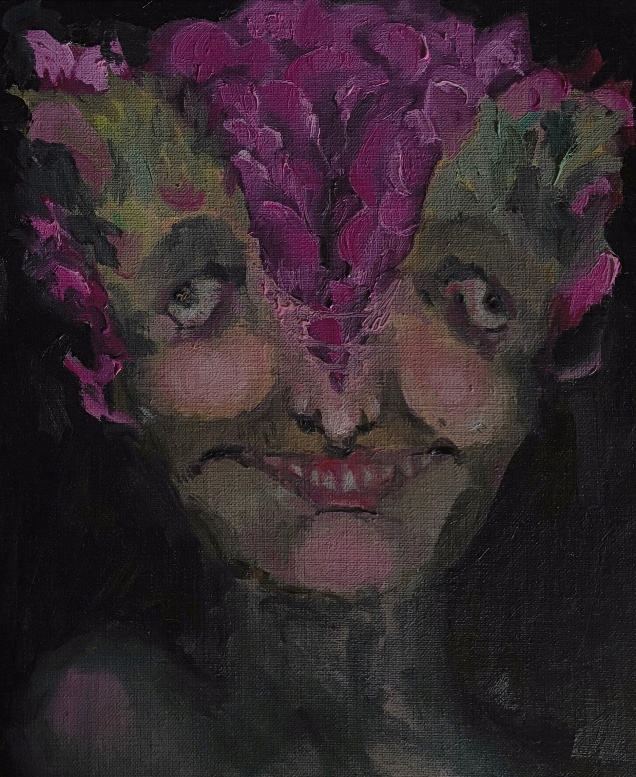
My first response could be described as an excess of sensation: the crisp coolness of the nighttime air, the harpy-like screeching of the train, its metal underbelly meeting the contours of one’s face.
My bodily awareness was already involved in the scene; I felt the weight and proximity of the description before I could determine what it meant. The idealisation it was said felt less like suicide and more like the moments of labour, as if the skull was swelling with pregnancy, carrying with it a creature that wanted its way out.
How The Play Drive Relates to My Experience
To understand how making this painting changed my relationship to myself, I first want to consider how my initial bodily response developed into an exchange between sensation and reflection. The fact that I felt the scene before consciously considering how to represent it seems to resonate with Schiller’s account of the relationship between the sensuous and formal drives: “The sensuous impulsion comes into play therefore before the rational impulsion, because sensation precedes consciousness.”[21] Once this initial wave had washed over me, I felt myself being pulled toward a dark, dusty background and the particular shades of pink peonies take up. I began asking myself how this sensuous experience could be communicated to others. This involved asking myself questions such as what are the things about a face that make them uncanny? Or what type of elements could I include to capture the feeling of contradiction between the peony and the tracks?
Schiller would describe this as my sensuous drive being briefly annihilated to make room for the formal dive.[22]
The two drives for this particular instance, in my own account, feed into one another. I do experience the threats they throw at one another, as described by Schiller. However, there is a nuance to this that I would like to briefly touch on. As described, the formal drive take hold once provoked by the sensuous drive, but in the formal drive’s temporary domination, it cannot help but ground itself back in the bodily sensations that prodded its awakening in the first place. I believe this happens because the mind takes what it gives itself through the formal drive and uses it to provoke a sensuous experience.
For example, when one imagines she is on top of a very tall building, she engages her formal drive, but her mind may often wonder toward the sensuous drive once more as she begins to experience the feeling of being on said tall building.
Given this I think we have better reason to interpret Schiller’s rise of the play drive as an ebb and flow on part of both the drives rather than a literal conflict. As illustrated below:
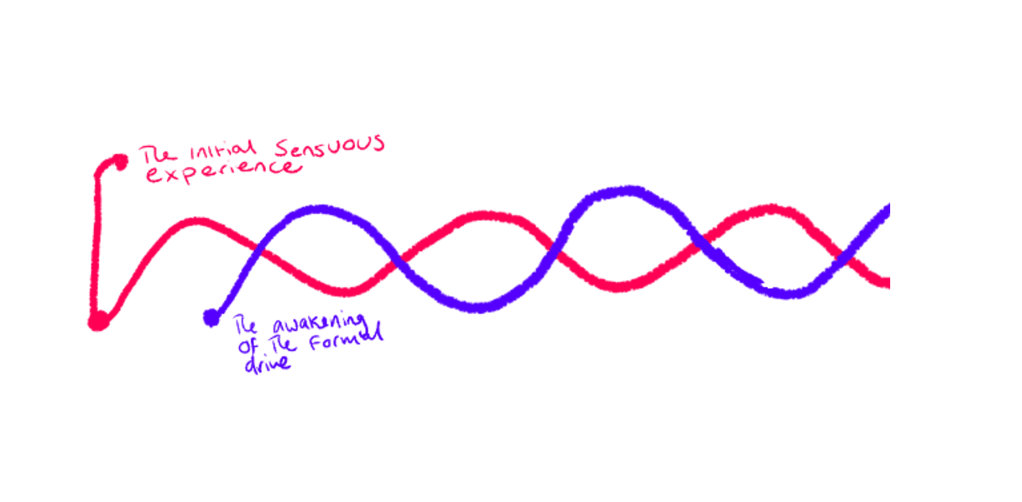
Figure 2: The ebb and flow of the two drives.
As the two drives feed into one another, I feel a very intense craving to unite them (in Schillerian terms). To go along with my visualisation: the curves separating the drives come closer together until they form a single straight line. This marks the beginning of the play drive and thus the artistic process. Painting became necessary because the experience could not be adequately preserved as either a factual description or a purely sensuous memory.

Figure 3: The Birth of The Play Drive.
Painting allowed me to move between immersion and reflection. I could return to the experience through colour, spatial arrangement, and material surface, while also modifying it through those formal decisions. This is where my analysis lends itself to Schillers account of aesthetic education. Referring to my brief outline of the two thinkers, the nature of the play drive allows one to think and feel together, which offers a new form of cognising outside of instrumental rationality. This movement from unformed affect to reflective expression illustrates how artistic practice can suspend instrumental rationality while also gradually reshaping the self that engages with the world.
How The Dionysian Relates to My Experience
There are also moments in this process that exceed this Schillerian balance. As the work develops, my usual distance from it can begin to dissolve. I no longer feel as though I am shaping an image from outside it. Instead, I become immersed in the atmosphere that the image creates. The work wraps around me, and I lose awareness of my peripheral vision. The painting demands that I adjust to it, and even though it comes into existence through my actions, parts of me are also manipulated and created by the painting—as if it were talking to me. While thought and sensation become difficult to separate, the line between the self and art also dissolves as we both influence each other.
This is the point at which my experience seems closest to Nietzsche’s Dionysian. The boundaries between the artist, the work, and the world temporarily become less secure. Because the Dionysian dissolves the detached, calculating self, the subject-position that instrumental rationality presupposes is suspended: there is no longer a sovereign agent standing apart from the world, positing ends and seeking efficient means to them. Instrumental rationality has no foothold because the self that would exercise it has been briefly undone.
Yet the Dionysian experience cannot continue indefinitely. Eventually, I return to a more differentiated awareness of myself as the artist and of the painting as an object that can be viewed, judged, revised, or abandoned. This return can be understood through Nietzsche’s account of the relation between the Dionysian and the Apollonian. Where the Apollonian gives the Dionysian a form through which it can be encountered and endured.
Can These Accounts Inform One Another?
But how can my aesthetic experience account for both the Dionysian and the Play Drive when one account demands a temporary release from the self, whilst the other describes a lasting transformation? This is where I would like to suggest an alternative way of conceptualising these two accounts. I believe that what the Dionysian describes is a particular point within the Play Drive, i.e., the Dionysian exists within Schillers framework.
If I could be allowed to continue with my visualisation for one last time:
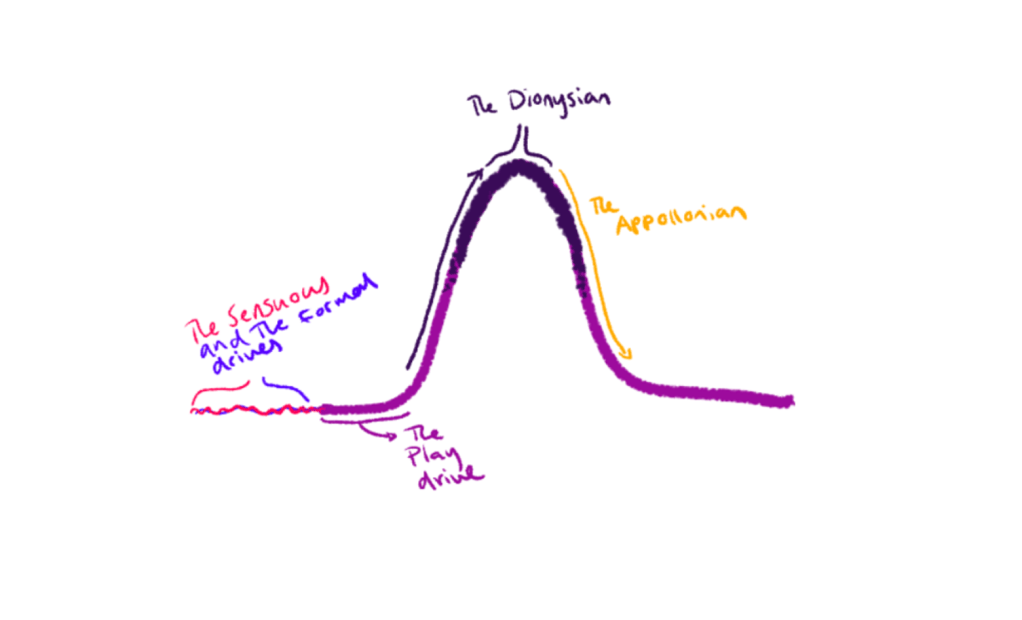
Figure 4: My Phenomenological account mapped onto a conceptualisation of the Play Drive and the Dionysian.
Here, both concepts have explanatory power, and it is necessary for both to remain true for the full aesthetic experience to be understood. I want to extend this explanatory power to each conceptualisation’s account of the self as well. In this way, The Dionysian does still dissolve the self, and Nietzsche is correct in saying this is temporary, but there are sequelae that follow from this instance which is best reflected in Schiller’s aesthetic education.
Given my phenomenological analysis, I don’t think there is much value in saying that we have more reason to either believe in Nietzsche or Schillers account of aesthetics. Rather, they describe different instances of the same process. This allows it to be the case that there is indeed a temporary release of the self (and therefore of instrumental reasoning) and a sustained transformation of the self in the same process or event.
Conclusion
How much does the practice of art change you? Over the course of this paper, I have tried to explore this by breaking it down into three questions: what about me changes when I make art, where in the artistic process does this change occur, and to what extent does it last? There are many ways to answer the first question; in this paper, I have focused on instrumental rationality as a way of describing a relationship to myself and the world that artistic practice may interrupt. What changes, in my account, is the extent to which I experience myself as a separate, calculating agent working towards a predetermined end. Making art does not remove practical reasoning, but it can allow my intentions to be reshaped by the experience rather than just directing it.
Schiller and Nietzsche help me locate this change in different moments of the artistic process. Through Schiller’s play drive, I understand the reciprocal movement between sensation and reflection, in which each informs and develops the other. Through Nietzsche’s Dionysian, I understand moments of immersion when the distinction between myself and the painting becomes less secure. My reflection seems to suggest that there is both a temporary and sustained change taking place and although these experiences differ, their effects do not have to be contradictory. A temporary loosening of selfhood can become part of a longer process through which the self learns to feel, judge, and act differently. My claim is therefore not that art completely abolishes instrumental rationality or that every act of making produces lasting change. It is that artistic practice can interrupt a predominantly calculative relationship to experience and create opportunities for self-transformation. Sometimes the change begins when I discover how to give an experience form. Sometimes it begins when the experience unsettles the person who thought they already knew what form it should take.
Jordyn is currently studying a Bachelors of Advanced Humanities. She finds herself very interested in what it means to be a person. She doesn’t want to boast but there are currently four types of moss in her backyard.
Bibliography
Geuss, Raymond, and Bernstein, J. M. “Critique of Instrumental Reason.” In Routledge Encyclopedia of Philosophy, 2016. https://doi.org/10.4324/9780415249126-S015-2.
Geuss, Raymond. “Introduction.” In The Birth of Tragedy and Other Writings, ed. Raymond Geuss and Ronald Speirs. Cambridge University Press, 1999.
Guyer, Paul. “The Beautiful and the Good.” In The Cambridge History of Philosophy in the Nineteenth Century (1790–1870). Cambridge University Press, 2012.
Nietzsche, Friedrich. The Birth of Tragedy. George Allen & Unwin, 1910. https://www.gutenberg.org/files/51356/51356-h/51356-h.htm.
Schiller, Friedrich. Letters Upon the Aesthetic Education of Man. Project Gutenberg, 2006. https://www.gutenberg.org/files/6798/6798-h/6798-h.htm.
Weber, Max. Economy and Society: An Outline of Interpretive Sociology. University of California Press, 1978.
[1] Gregory Smulewicz-Zucker, “The Frankfurt School and the Critique of Instrumental Reason,” in The Palgrave Handbook of Critical Theory (Palgrave Macmillan, 2017), 186.
[2] Weber, Max. Economy and Society: An Outline of Interpretive Sociology (University of California Press: 1978), 26.
[3] Smulewicz-Zucker, “The Frankfurt School and the Critique of Instrumental Reason,” in The Palgrave Handbook of Critical Theory (Palgrave Macmillan, 2017), 189.
[4] Friedrich Schiller, Letters upon the Aesthetic Education of Man, Project Gutenberg, 2006,
https://www.gutenberg.org/files/6798/6798-h/6798-h.htm. Letter 6.
[5] Schiller, Letters upon the Aesthetic Education of Man, Letter 6.
[6] Paul Guyer, “The Beautiful and the Good,” in The Cambridge History of Philosophy in the Nineteenth Century (1790–1870) (Cambridge University Press, 2012), 349.
[7] Geuss and Bernstein, “Critique of Instrumental Reason.”
[8] Guyer, “The Beautiful and the Good,” 349.
[9] Schiller, Letters upon the Aesthetic Education of Man, Letter 13.
[10] Schiller, Letters upon the Aesthetic Education of Man, Letters 14–15.
[11] Schiller, Letters upon the Aesthetic Education of Man, Letter 14.
[12] Schiller, Letters upon the Aesthetic Education of Man, Letter 15.
[13] Guyer, “The Beautiful and the Good,” 333–38.
[14] Schiller, Letters upon the Aesthetic Education of Man, Letter 27.
[15] Raymond Geuss, “Introduction to Friedrich Nietzsche,” in The Birth of Tragedy and Other Writings (Cambridge University Press, 1999), 48.
[16] Friedrich Nietzsche, The Birth of Tragedy (George Allen & Unwin, 1910), 26.
[17] Nietzsche, The Birth of Tragedy, 26.
[18] Geuss and Bernstein, “Critique of Instrumental Reason.”
[19] Raymond Geuss, “Introduction to Friedrich Nietzsche,” in The Birth of Tragedy and Other Writings (Cambridge University Press: 1999), 57.
[20] Nietzsche, The Birth of Tragedy, 119.
[21] Friedrich Schiller, Letters upon the Aesthetic Education of Man, Letter 20 (Project Gutenberg, 2006), https://www.gutenberg.org/files/6798/6798-h/6798-h.htm.
[22] Schiller, Letters upon the Aesthetic Education of Man, Letter 20.
Featured Image: Jordyn Garvie, Untitled, Oil on Canvas, 2026.


