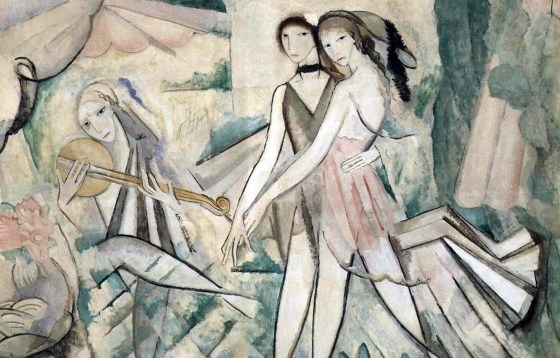
In this essay, Liv Evans takes an encounter with a Pompeiian fresco often associated with Sappho as an opportunity to place Walter Benjamin’s better-known and more polemical account of aura in conversation with his other writings on translation and history, as well as with a broader tradition of queer scholarship concerned with how we relate to an absent and fragmentary past. By complicating the apparent opposition between aura and reproducibility, Evans explores the possibilities that arise from reconceiving their relation as entangled and generative, suggesting that reproduction may be understood to emerge from and itself become a site of auratic distance. As this exploration unfolds, Sappho becomes both the imagined subject of the painting and a philosophical voice through which to think about the ethical and political significance of aesthetic and temporal relations, and about what auratic distance, when freed from institutional authority, might offer: the possibility of re-encountering, re-creating, and remembering, “even in another time.”
Category: Issue 14
Por un futuro que es mío y mestizo
In this critical reflection I focus on themes of cultural identity and hybridity in the age of AI through an exploration of the challenges I faced when AI generating a CV to communicate my skills, my strengths, and most importantly, my story to a potential employer. This essay analyses the ways that AI perpetuates Western colonial frameworks and, in doing so, fails to capture the complexity of hybrid identities when crafting personal narratives. For a deeper understanding of the conflicting feelings that emerged through this process I turn to the work of Frantz Fanon and Gloria Anzaldúa. Through this reflection I explore both the depths of my hybrid identity and my opposition to any attempts to constrain this ‘mestizaje’.
Benevolent Anthropocentrism and the Problem of Selfishness
This paper investigates William Grey’s claim that a moderate conception of anthropocentrism is not only inevitable, but also conducive to the promotion of a thriving biosphere. It considers the underlying motivational externalist basis of Grey’s anthropocentrism and highlights a risked incoherence between Grey’s two premises: anthropocentric inevitability and prescribed benevolent action. Illuminating this tension, this paper questions the legitimacy of motivation as an appropriate yardstick for measuring the efficacy of a normative framework. It concludes that beyond mere arbitrary distinction, anthropocentrism fails as a compelling alternative to aspirational rationalist frameworks of environmental ethics.
What Gets Lost in Literary Translation: Walter Benjamin and the Limits of Meaning
Translation, frequently conceived as a technical operation concerned primarily with the identification of lexical and structural equivalents between languages, demands a more searching philosophical examination — one this paper undertakes through the lens of Walter Benjamin’s essay “The Task of the Translator” and, to a lesser extent, Benjamin Constant’s reflections on the cultural mediation inherent in all translation. Benjamin’s central contention — that translation is not a communicative act in any conventional sense but rather a mode of survival through which the original text persists in a transformed state, its afterlife constituted precisely by the loss and gain that translation entails — offers a framework for understanding why certain words resist straightforward transfer between languages. Drawing on this framework and supplemented by Constant’s recognition that rendering a text from one language to another is always shaped by the translator’s own cultural and historical position, I examine a series of translation challenges encountered in rendering Angela Slatter’s short story Ash from English into French. Lexical items such as “gainsay,” the phrasal construction “her kind,” and the declarative statement “I did not warm his bed,” resist translation — not because of any inherent linguistic complexity, but because they are embedded in culturally specific matrices of meaning: forms of life, to invoke Wittgenstein’s terminology, that are irreducible to other linguistic and cultural frameworks. These examples illuminate a broader philosophical claim, namely that untranslatability is not a failure of translators but a constitutive condition of language itself, and that translation, on this view, is not about carrying meaning across borders but about recognising the limits of what can be carried, marking the gap between worlds, and choosing to translate regardless.
Congratulations, You’re Included! Now, You’re Under Arrest: Arendt and Colonial Forms of Rightlessness
This paper offers a critique of Hannah Arendt’s account of the “right to have rights” in The Origins of Totalitarianism (1951). While accepting Arendt’s claim that rights depend upon political belonging rather than humanity alone, it argues that her framework fails to capture rightlessness produced through coercive legal inclusion. The argument draws on Irene Watson and Sharon Venne’s critique of state-administered Indigenous rights, using the criminalisation and over-incarceration of Indigenous Australians to demonstrate that recognition by law does not necessarily restore political standing. Instead, colonial law can render Indigenous peoples visible primarily as subjects of policing and punishment while denying their authority as self-determining peoples. The paper concludes that Arendt’s account, including her analysis of assimilation, is sensitive to exclusion and defective belonging. Yet, settler-colonial rightlessness reveals a limitation: having rights requires not merely belonging to a political community but belonging as a people capable of self-determination.
How much does the practice of art change you? Applying Nietzsche’s Dionysian and Schiller’s Play Drive to Lived Experience
Jordyn Garvie examines whether artistic practice can offer a way out of the instrumental rationality diagnosed by the Frankfurt School. Drawing on Friedrich Schiller’s account of the play drive and Friedrich Nietzsche’s distinction between the Apollonian and the Dionysian, Garvie reconstructs two competing pictures of aesthetic experience: one argues for a lasting transformation of the self, the other offering only temporary dissolution of individuation. Through a phenomenological case study from her own work as a visual artist, the essay argues that these are not rival claims but successive moments in a single process. Art thus emerges as a site where instrumental rationality is suspended, and the self is both undone and remade.
Essentialised Disruption? Rancière, Catholic Drag, and the Police Order
Jacques Rancière’s theory of aesthetics concerns what is sensible—that is what is visible, sayable, intelligible, and perceptible in a specific social order. This provides a framework for examining how aesthetic acts by marginalised peoples might reshape their position within society. In this essay, Mia Bock evaluates Jacques Rancière’s claim that aesthetic acts shape experience to create new modes of perception and forms of political subjectivity through a case study of a queer Catholic drag performance. Bock argues that although Rancière successfully demonstrates how aesthetic acts facilitate political subjectivisation through an agent’s enactments of their inherent equality, this does not mean that disruption necessitates a redistribution of the sensible. While aesthetic acts may indeed render excluded subjects visible, they do not always entail new intelligible possibilities. Where marginalised identities are already understood through stereotypes of disruptiveness, aesthetic disruptions may be interpreted as confirming rather than reconfiguring existing modes of perception.