By Liv Evans
someone will remember us
I say
even in another time
— Sappho, trans. Anne Carson
If asked to picture Sappho, I – and, I suspect, many others – would be inclined to think of a young woman with a soft, pensive stare, pressing the end of a stylus to her lips. This image derives from a Pompeiian fresco that, although once misidentified as a depiction of the archaic poet, is now widely agreed not to relate to her at all;[1] yet, in digital queer cultural spaces, where the reproduced image proliferates, this correction seems to matter very little. Having become familiar with this image in such contexts, I had the opportunity in 2024 to see the real painting in the National Archaeological Museum of Naples, where I found myself torn between an expected sense of transcendent recognition and an inescapable sense of estrangement: a sense of both losing her and finding her at once. In this essay, I read this encounter as a lens through which to explore Walter Benjamin’s conception of aura and reproduction in his 1935 essay “The Work of Art in the Age of Mechanical Reproduction,” and as an opportunity to consider these ideas alongside aspects of his writings on translation and history, as well as late twentieth-century theories of queer temporality. Whilst my experience with the “Sappho” fresco resonates with a standard Benjaminian interpretation of the decline of aura under conditions of mechanical reproduction, it also brings into view aspects of aesthetic experience that do not sit neatly within it, opening possibilities for complicating the apparent opposition between aura and reproducibility.
Nonetheless, a conventional reading of the “Artwork” essay remains an important framework for understanding the ways in which my encounters with “Sappho” appear to exemplify this account of the decline of aura under mechanical reproduction. In the essay, Benjamin presents aura as a quality that emerges from the authenticity of the traditional artwork, for which “the presence of the original is a prerequisite,” and defines it as “the unique phenomenon of a distance, however close it may be.”[2] Technical reproducibility, which erodes the significance and stability of authentic presence, is thus framed in opposition to “the aura of the work of art,” which “withers in the age of mechanical reproduction.”[3] This decline can be illustrated through the example of digital reproductions of the Sappho fresco, which exemplify the idea that in liberating the object from “the domain of tradition,” the technique of reproduction permits “the reproduction to meet the beholder […] in his own particular situation” and thus “reactivates the object reproduced.”[4] In being reproduced, the image is detached from its context and reinserted into new contexts in which it acquires new meanings, including its reading as evidence of a lesbian sister, “an ancestor in a long chain of like beings.”[5] This process thus collapses the distance that defines aura, and instead fosters a sense of similarity and intimacy derived from the decline of historical authenticity.
By contrast, the authentic fresco encountered in the gallery context possesses that which is lacking in “even the most perfect reproduction of a work of art”: its “presence in time and space, its unique existence at the place where it happens to be.”[6] The unique here-and-now of the painting emerges from its undeniable materiality and presence which, by situating it in a singular historical continuity of creation and survival, serve “testimony to the history which it has experienced” and thus reassert its singularity and authenticity.[7] Standing in that Naples museum, my identification of the figure with a mythologised Sappho is interrupted by the fresco’s irreducible specificity. I cannot help but know that this painted stone was once a wall in a Pompeiian house, or that it was excavated merely 25 kilometres away, from the ruins of the wrong era. Faced with its material presence, and the history it implies, I experience what I logically knew: that it cannot be Sappho. This moment of recognition produces a sense of estrangement consistent with Miriam Bratu Hansen’s claim that the auratic “confronts the subject with a fundamental strangeness in the self” because it involves “the gaze of the object, however familiar, [being] experienced by the subject as other and prior, strange and heteronomous.”[8] A multifaceted sense of auratic distance-despite-proximity thus emerges, from both the gallery conventions that enforce my physical separation from the untouchable painting, and from the interpretive distance that arises from the fact that in light of its historical embeddedness, I cannot subsume it into my appropriative reading; it cannot be mine. Through its unapproachability, which for Benjamin is “a major quality of the cult image,” the painting thus retains elements of its ritual function and auratic quality.[9] In this sense, my encounter aligns with an understanding of aura as tied to the material presence of the authentic work and opposed to reproducibility.
However, this apparent opposition becomes unstable when aura is understood not as an inherent essence of an original work, but as something that emerges through perceptual relation. This understanding emerges from Benjamin’s later articulation that “to perceive the aura of an object we look at means to invest it with the ability to look at us in return,”[10] as it suggests that aura emerges in the relational encounter between artwork and beholder, wherein the reciprocity of the gaze produces a perceptible sense of distance. Aura is thus not an inherent quality of traditional works as it instead, as Hansen argues, “implies a phenomenal structure that enables the manifestation of the gaze, inevitably refracted and disjunctive, and shapes its potential meanings.”[11] Encounters with circulated reproductions may become part of this relation, as their familiarity may influence perceptions of the original; the conceptual afterlives of a work thus offer another layer of historicity that is not materially inscribed but still perceptually active. Although my experience of the authentic fresco’s aura aligns with Benjamin’s account, I suggest that the sustained rupture between anticipated intimacy and reality intensified this sense of aura by making the distance perceptible. Thus, what appears as an absolute opposition may be better understood as a relation of mutual constitution, in which reproduction participates in the very conditions through which aura becomes perceptible; “aura thrives in its decline.”[12]
Such an understanding opens the possibility that reproductions may produce auratic effects by sustaining a felt relation to an irrecoverable elsewhere or absent original. Where Benjamin’s argument in the artwork essay suggests that exhibition value comes to replace cult value, as reproducibility “substitutes a plurality of copies for a unique existence,”[13] this reading suggests that the emergence of reproducibility instead places these values in tension. In my experience of the “Sappho” fresco, the existence of a plurality of reproductions fostered a longing for the distant original, as the proximity and availability of the online images only intensified the sense that it was not fully real, not here, not mine. This dynamic extends beyond the fresco to the many reconstructions and translations of the surviving fragments of her poetry, wherein, as Page DuBois notes, “Sappho herself persists elusively always as an absent source […], as an origin we can never know.”[14] As no stable original is accessible, encounters with Sapphic texts are necessarily mediated by loss and incompletion, where the authenticity and presence of the original is felt, across time, through its absence. Just as the poems themselves thematize pothos – “a yearning for someone absent, for a lost time, a lost pleasure”[15] – aesthetic relations to these fragmentary, reconstructed texts, and to the appropriated images through which the poet is continually reimagined, are structured by longing and lacunae. They are structured by what may be described, in Benjamin’s terms, as the “unique phenomenon of a distance, however close it may be.”[16]
Aura may thus be understood as transformed in the age of mechanical reproduction, rather than fully replaced, insofar as a reproduction – as Benjamin remarks of translation – may preserve “an echo of the original [that] can be awakened in it.”[17] Samuel Weber’s formulation that aura may return “because, as the appearance or apparition of an irreducible separation, it was never uniquely itself but always constituted in a process of self-detachment” helps explain this persistence.[18] Because a reproduction always bears a trace of the absent or erased original from which it constitutes itself, its very structure echoes the sense of “detachment from the self as demarcation of a self” that Weber identifies as the structure of aura.[19] The artwork essay itself presents this possibility, as in Benjamin’s account of early photography – a medium primarily associated with reproducibility – he suggests that “the cult of remembrance of loved ones, absent or dead, offers a last refuge for the cult value of the picture,” as in meeting the gaze of the absent other across an irreducible temporal distance, “aura emanates […] in the fleeting expression of a human face.”[20] As such, I am inclined to agree with Hansen’s view that the more polemical celebration of aura’s decline in the 1935 essay can be read as part of a “strategy of preserving the potentiality of aura,” while removing the fascistic and traditional connotations that limit it, “by plac[ing] it under erasure” in order to “use the demolished fragments of auratic perception in other concepts.”[21] Although this aura of reproduction importantly differs from that of traditional artwork in that it is no longer beholden to institutional authority, there is nonetheless a connection between the traditionally auratic gaze that is returned and the gaze that structures our encounter with the reproduction as “a recording of the experience of absence, the processes of seeing and not seeing.”[22] They may be reconciled in this idea of the gaze of the apparatus, which “does not look back and yet sees.”[23]
More radically, these instances of Sapphic reproduction suggest that auratic distance may, in some sense, enable reproduction itself, as absence is the medium through which relation and reimagination become possible. As Weber notes, the notion of bringing something closer “presupposes a point or points of reference that are sufficiently fixed […] to allow for the distinction between closeness and farness, proximity and distance.”[24] Thus, “the desire of contemporary masses to bring things ‘closer,’ spatially and humanly,”[25] which underpins reproducibility, may be interpreted as a response to auratic distance, which generates longing, relation, and ultimately the desire to reach towards.[26] To return to Sappho, her poetry offers us a staging of this dynamic, as it is characterised by a “familiar mood of longing for an absent woman, whose absence generates the poem itself.”[27] Confronted with the fragmentary text, DuBois argues, “the reader assumes the position […] of the poet” and engages in an act of reading that is always “an attempt to constitute the missing fruit, the missing maiden, to bring them to life in words that must always betray the materiality of the real.”[28] Similarly, it is the absence of Sappho that leads to this proliferation of translations, reconstructions, and queer appropriations (including the re-contextualised fresco); it is the impossibility of fully recovering or possessing Sappho that creates space for continual identification and re-creation.
This idea of distance and relation, which aligns with what Carolyn Dinshaw describes as a “queer historical impulse” that emerges from a desire “for partial, affective connection, for community, for even a touch across time,”[29] allows us to conceptualise the political and ethical implications of reproducibility and auratic experience. In theorising this queer temporality, Dinshaw herself refers to Benjamin’s image of the constellation, in which “starry lights are emitted at different times even as they are perceived at once, together,” to articulate a historical relation that “revises any positivistic relation of past events to each other and to the present.”[30] For our purposes, Benjamin’s rather complex idea of history, which is most clearly defined as “the subject of a structure whose site is not homogenous, empty time, but time filled by the presence of the now [Jetztzeit]” [31] can be approached as an argument against bourgeois historicism. Rather than narrating events as a continuous sequence, the historical materialist – in Benjamin’s unorthodox sense of the term – “grasps the constellation which his own era has formed with a definite earlier one,”[32] and in doing so brings the past into a new, potentially redemptive relationship with the present. Crucially, however, this mode of temporal relation depends on preserving the distance between past and present, even as they are brought together in this “time of the now.”[33] The “relation of what–has–been to the now” corresponds to what Benjamin terms the dialectical image; it is “dialectics at a standstill.”[34] Apprehending history as a dialectical image thus involves arresting their relation at a moment of legibility, where the past is brought into and made significant in the present without being subsumed into a narrative of continuous historical progress (and thus stripped of its emergent revolutionary potential). As such, as Adrianne Conty asserts, it is the “infinite distance” that fills the time of the now that presents “the possibility of justice that Benjamin calls the messianic;” [35] the unresolved tension between proximity and distance enables the emergence of new and potentially revolutionary relations.
Conty also draws a connection between Benjamin’s idea of the redemption of history and reproducibility: “like the unique work of art, the unique historic event is wrenched from its context in order to be reproduced, re-enacted in and as present,” which “undermines the temporal continuity that mummifies and makes the past somehow inviolable, like the cult image.”[36] Thus, although Benjamin’s philosophy of history is distinct from the idea of auratic reproduction developed in this essay, there are nonetheless some interesting resonances between them. These resonances suggest the possibility that some acts of reproduction may similarly disrupt the exclusionary authority of institutions and normative historicism to make the past politically meaningful in the present. It is this possibility, I suggest, that might explain the strange sense of inspiration that accompanied my experience of the gallery fresco. The competing interpretations of the painting disclosed through the encounter – as not Sappho, and yet inevitably, as always her to me – reveal that I have no image of Sappho but the ones I continually take and make for myself; in some sense, I discovered my own capacity to participate in the production of meanings and to insist on my desire for a touch across time. Thus, this reading of aura retains Benjamin’s argument in the artwork essay that the age of mechanical reproduction’s emancipation of art “from its parasitical dependence on ritual” enables its “democratisation and politicisation” not only by making art more widely accessible, but in making possible new and transformative relations with it that exceed or challenge predominant interpretations.[37] The significance of such aesthetic experiences, then, may lie in their capacity to sustain these possibilities of reimagination and creation, so that the fragmentary text may become – as McLaughlin suggests of Anne Carson’s translation of Sappho – a non-institutional “‘free space of imaginal adventure’ that invites readers to handle, touch, and matter the translation on their own terms.”[38]
Ultimately, this exploration affirms the value of thinking with Benjamin’s conception of aura, as the formulation of the opposition between aura and reproducibility in the artwork essay not only provides a compelling account of what is lost and what might be gained in technological reproduction, but also offers an immanent potential for its own complication and extension. Although such an undertaking could disappear into a reflexive labyrinth of deconstruction and inversion, allowing aura to entangle with other ideas of experience, time, desire, language, and the self nonetheless offers the possibility of enriching theorisations of aesthetic experience, and of re-encountering, re-creating, and remembering, “even in another time.”[39]
Liv Evans is a second-year Bachelor of Advanced Humanities (Honours) student, completing a double major in Literature and Philosophy. Her philosophical interests include literary theory, temporality, hauntology, and more recently questions of ethics and alterity. She is also a lapsed jazz drummer.
Bibliography
Barthes, Roland. Camera Lucida: Reflections on Photography. Hill and Wang, 1981.
Benjamin, Walter. “The Work of Art in the Age of Mechanical Reproduction.” In Media and Cultural Studies: Keyworks. Blackwell, 2006.
———. “On Some Motifs in Baudelaire.” In Illuminations. Schocken Books, 1968.
———. “Theses on the Philosophy of History.” In Illuminations. Schocken Books, 1968.
———. “The Translator’s Task, Walter Benjamin (Translation).” TTR: Traduction, Terminologie, Rédaction 10 (1997): 151. https://doi.org/10.7202/037302ar.
———. The Arcades Project. Harvard University Press, 1999.
Conty, A. “They Have Eyes That They Might Not See: Walter Benjamin’s Aura and the Optical Unconscious.” Literature and Theology 27 (2013): 472–86. https://doi.org/10.1093/litthe/frt035.
Dinshaw, Carolyn. Getting Medieval: Sexualities and Communities, Pre- and Postmodern. Duke University Press, 1999.
DuBois, Page. Sappho Is Burning. University Of Chicago Press, 1995.
Hansen, Miriam Bratu. “Benjamin’s Aura.” Critical Inquiry 34 (2008): 336–75. https://doi.org/10.1086/529060.
McLaughlin, Maggie. “Let Loose Your Longing: Erasure, Citation, and Lesbian Matter in Anne Carson’s Translation of Sappho’s Poetry.” Classical Receptions Journal 18 (2026). https://doi.org/10.1093/crj/clag008.
Sappho. If Not, Winter: Fragments of Sappho. Vintage Books, 2003.
Silberberg-Peirce, Susan. “The Muse Restored: Images of Women in Roman Painting.” Woman’s Art Journal 14 (1993): 28-36. https://doi.org/10.2307/1358447.
Weber, Samuel. “Mass Mediauras, Or: Art, Aura and Media in the Work of Walter Benjamin.” In Mass Mediauras: Form, Technics, Media, edited by Alan Cholodenko. Stanford University Press, 1996.
[1] Susan Silberberg-Peirce, “The Muse Restored: Images of Women in Roman Painting,” Woman’s Art Journal 14 (1993): 33–34, https://doi.org/10.2307/1358447.
[2] Walter Benjamin, “The Work of Art in the Age of Mechanical Reproduction,” in Media and Cultural Studies: Keyworks, (Blackwell, 2006), 20-22.
[3] Benjamin, “The Work of Art,” 21.
[4] Benjamin, “The Work of Art,” 21.
[5] DuBois, Sappho Is Burning (University of Chicago Press, 1995), x.
[6] Benjamin, “The Work of Art,” 20.
[7] Benjamin, “The Work of Art,” 21.
[8] Miriam Bratu Hansen, “Benjamin’s Aura,” Critical Inquiry 34 (2008): 345, https://doi.org/10.1086/529060.
[9] Benjamin, “The Work of Art,” 35.
[10] Walter Benjamin, “On Some Motifs in Baudelaire,” in Illuminations (Schocken Books, 1968), 188.
[11] Hansen, “Benjamin’s Aura,” 342.
[12] Samuel Weber, “Mass Mediauras, Or: Art, Aura and Media in the Work of Walter Benjamin,” in Mass Mediauras: Form, Technics, Media (Stanford University Press, 1996), 101.
[13] Benjamin, “The Work of Art,” 21.
[14] Page DuBois, Sappho Is Burning, 29.
[15] DuBois, Sappho is Burning, 29.
[16] Benjamin, “The Work of Art,” 22.
[17] Walter Benjamin, “The Translator’s Task, Walter Benjamin (Translation),” TTR: Traduction, Terminologie, Rédaction 10 (1997): 151, https://doi.org/10.7202/037302ar.
[18] Weber, “Mass Mediauras,” 87-88. See also Hansen, who similarly argues that the “salient features of auratic experience – temporal disjunction, the shocklike confrontation with an alien self” are “asymmetrically entwined rather than simply incompatible with technological reproducibility and collective reception,” 350.
[19] Weber, “Mass Mediauras,” 87-88.
[20] Benjamin, “The Work of Art,” 24. This description of photography is also very reminiscent of Roland Barthes’ account in Camera Lucida: Reflections on Photography, (Hill and Wang, 1981), 96: “But the punctum is: he is going to die. I read at the same time: This will be and this has been […]. In front of the photograph of my mother as a child, I tell myself: she is going to die: I shudder, like Winnicott’s psychotic patient, over a catastrophe which has already occurred. Whether or not the subject is already dead, every photograph is this catastrophe.”
[21] Hansen, “Benjamin’s Aura,” 357. Here Hansen specifically identifies the mimetic faculty and the optical unconscious as the “other concepts” through which auratic experiences are expressed; elsewhere she also includes Benjamin’s engagement with Proust’s notion of mémoire involontaire.
[22] DuBois, Sappho is Burning, 10.
[23] Weber, “Mass Mediauras,” 104.
[24] Weber, “Mass Mediauras,” 88.
[25] Benjamin, “The Work of Art,” 22.
[26] My turn towards desire here is informed by Lacanian formulations of desire as metonymy and by Anne Carson’s articulation of desire as a (particularly spatio-temporal) paradox in Eros the Bittersweet.
[27] DuBois, Sappho is Burning, 188.
[28] DuBois, Sappho is Burning, 52.
[29] Carolyn Dinshaw, Getting Medieval: Sexualities and Communities, Pre- and Postmodern (Duke University Press, 1999), 21, 2.
[30] Dinshaw, Getting Medieval, 17-18.
[31] Walter Benjamin, “Theses on the Philosophy of History,” in Illuminations, (Schocken Books, 1968), XIV, 261.
[32] Benjamin, “Theses on the Philosophy of History,” A, 263.
[33] Benjamin, “Theses on the Philosophy of History,” A, 263.
[34] Walter Benjamin, The Arcades Project, (Harvard University Press, 1999), [N2a,3] 462. Emphasis added for ease of reading.
[35] Adrianne Conty, “They Have Eyes That They Might Not See: Walter Benjamin’s Aura and the Optical Unconscious,” Literature and Theology 27 (2013): 480, https://doi.org/10.1093/litthe/frt035.
[36] Conty, “They Have Eyes That They Might Not See,” 479.
[37] Benjamin, “The Work of Art,” 23.
[38] Maggie McLaughlin, “Let Loose Your Longing: Erasure, Citation, and Lesbian Matter in Anne Carson’s Translation of Sappho’s Poetry,” Classical Receptions Journal 18 (2026), 7. https://doi.org/10.1093/crj/clag008.
[39] Sappho, If Not, Winter: Fragments of Sappho (Vintage Books, 2003), 297.
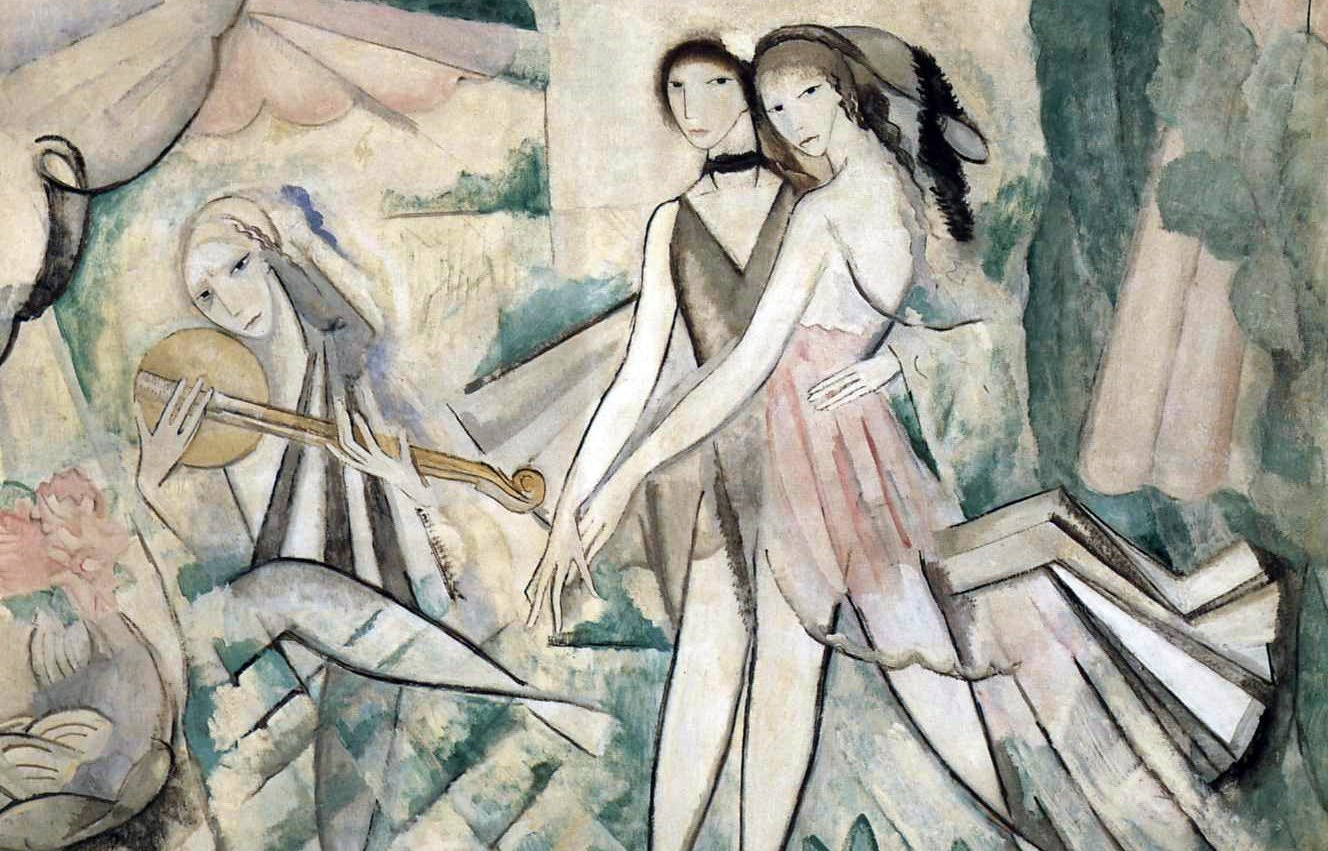
Featured Image: Marie Laurencin, The Elegant Ball, oil on canvas, 1910.


