By Tessa Popple
Hannah Arendt introduces the notion of ‘a “right to have rights”’ in The Origins of Totalitarianism, challenging the understanding of human rights as entitlements inherent in humanity. By diagnosing their collapse in the historical context of Nazism and Stalinism, she shows that rightlessness entails a state in which one’s words and actions fail to possess political force.[1] Rights, on this view, are not abstract entitlements that inhere in humanity but rather depend upon an organised political world that meaningfully interprets them.[2] Although Arendt develops this account through the figure of the stateless person, her analysis of assimilation also recognises that political inclusion can be conditional and coercive. Yet settler-colonial conditions raise a further question concerning the authority under which rights are recognised. As Irene Watson and Sharon Venne argue, the recognition of Indigenous rights within a colonial legal framework can preserve the state’s authority to determine the terms of Indigenous political existence, without confronting the legitimacy of Indigenous self-determination.[3] This essay argues that Arendt’s formulation of the right to have rights encounters a fundamental limit in the context of Indigenous political experience. Although her account of statelessness identifies political belonging as the condition of meaningful rights, and her discussion of the parvenu recognises the coercive dimensions of inclusion, neither adequately addresses the imposition of political authority upon peoples who have been denied full self-determination. Drawing upon Watson and Venne’s critique of colonial recognition, I argue that the criminalisation and over-incarceration of Indigenous Australians reveal a form of political subordination that Arendt’s framework cannot fully accommodate. Indigenous peoples are juridically incorporated within the settler state while their continuing collective authority remains subordinated to its jurisdiction. Criminalisation demonstrates how this imposed legal order reproduces colonial rightlessness through the very institutions that recognise Indigenous peoples as legal subjects.
Arendt develops her account of the right to have rights through the experience of statelessness, in which the loss of national citizenship exposes the limitations of rights thought to be guaranteed by humanity alone. The denationalisation and displacement of minority populations in twentieth-century Europe, most notably Jews, revealed that in certain political conditions, human rights become unintelligible.[4],[5] For Arendt, this failure exposed a mistake within the conception of human rights as entitlements possessed independently of political membership. When individuals were deprived of a political community capable of recognising and guaranteeing their rights, their status as human beings offered no effective protection. If human rights truly inhered in the human as such, their protection would remain regardless of expulsion from the political community.
The significance of this loss extends beyond the deprivation of particular civil or political entitlements. Arendt identifies the fundamental condition of rightlessness as the loss of a “place in the world” in which one’s opinions are significant and one’s actions effective.[6] Rightlessness is therefore a fundamentally political condition, concerning the loss of membership in a community in which individuals can participate in a shared world as speaking and acting beings. Political belonging cannot be reduced to formal citizenship or recognition before the law, although these may provide important institutional conditions for its exercise. The right to have rights describes the more fundamental condition of belonging to a political community in which rights can be meaningfully claimed and exercised. Detached from political belonging, the language of ‘human rights’ persists, but without force.
This entails a stronger claim, as argued by Étienne Balibar in his formulation of ‘Arendt’s theorem’: Arendt reverses the liberal order of justification. Rather than deriving civil rights from pre-political human rights, she shows that human rights depend upon political institutions that make them effective.[7] Arendt does not aim to show a pragmatism—that what is lacking from rightlessness is the force to be enforced—but rather that the political and ontological dimensions of human being have no effective status separated from the institutional relations through which they appear as rights-bearing beings. The collapse of citizenship shows that, in the absence of political belonging, human rights lose coherence. The right to have rights describes the political conditions under which every other right becomes legible; it is not another entitlement existing within a catalogue of rights.
Deprived of membership in a political community, Arendt discusses the stateless person as an “anomaly for whom there is no appropriate niche in the framework of the general law.”[8] Arendt observes that committing a minor offence may paradoxically improve their legal position, since “[o]nly as an offender against the law can he gain protection from it.”[9] The criminal occupies a recognised position within the legal order and is consequently entitled to protections that the innocent stateless person cannot claim. The example exposes the dependence of legal rights upon a recognised juridical status, demonstrating how the loss of political membership can leave individuals without the ordinary protections of law. Arendt’s account thus identifies rightlessness through the absence of a secure place within a political and legal order. The stateless person remains without the ordinary legal protections afforded to even criminals, and they are thus vulnerable to arbitrary treatment. Recognition is preferable to non-status because it signals re-entry into a shared world in which one’s existence registers under common norms.
Arendt’s criminality paradox establishes the dependence of legal protection upon a recognised position within a political and juridical order. The stateless person’s predicament arises from their exclusion from the ordinary framework of law, while recognition as an offender can paradoxically afford protections otherwise unavailable to them. Yet this account leaves unresolved the conditions under which political and legal membership is established whilst rightlessness persists. Arendt’s paradigm case is the stateless person expelled from a political order; settler colonialism produces a different relation. Indigenous peoples differ from those who have lost membership in a state to which they once belonged, as in Arendt’s statelessness. Instead, they are peoples whose existing political orders were displaced, and their political membership was forcibly subsumed by a colonial state that maintains sovereign authority.
The parvenu complicates any reading of Arendt in which rightlessness is understood solely as exclusion and expulsion from a political community. In “The Jew as Pariah” (1944), she considers acceptance as possible but dependent upon the suppression of social and political distinctiveness.[10] The parvenu seeks acceptance within a dominant social order by suppressing the identity that marks them as an outsider. Rather than challenging social discrimination, the parvenu conforms to the standards of the dominant class, seeking individual advancement through assimilation. There exist two aspects of belonging: whether one does, and under what conditions. However, the Indigenous person differs to the parvenu. Where the parvenu seeks acceptance within an existing order, Indigenous peoples are subjected to a colonial legal order that asserts jurisdiction over their continuing political existence. Arendt’s analysis of assimilation remains structured by defective belonging: the assimilated subject is not fully included, and domination appears as a failure of genuine membership. By contrast, the condition described here is not one of failed inclusion but of subordinated inclusion. Indigenous Australians are incorporated within the legal order, yet this inclusion takes the form of governance without the authority to self-determine.
Watson and Venne’s critique of contemporary human rights frameworks develops this problem in the context of modern settler-colonialism. Their concern is that by International
Law recognising Indigenous rights, even in an effort to protect them, what is preserved is the authority of the colonial state to determine Indigenous political existence.[11] The problem extends to the imposition of a political order that denies the authority of the peoples it governs. Legal recognition may therefore provide particular rights and protections without challenging the colonial relationship through which those rights are granted. As Watson and Venne emphasise, colonialism remains an ongoing condition for which existing human rights mechanisms have failed to provide an effective remedy.[12] This limitation is structural: the colonial state cannot by recognition alone secure Indigenous self-determination through a rights framework under which they posit, arbitrate, and govern Indigenous political existence. Self-determination, on this view, concerns the collective authority of Indigenous peoples to determine their political and legal relations rather than mere recognition within an existing state framework.[13]
Read alongside Arendt, Watson and Venne thus expose a further dimension of political rightlessness. If meaningful rights depend upon political belonging, as Arendt argues, then the conditions under which that belonging is established are significant. For Indigenous peoples especially, these conditions cannot be separated from self-determination. Yet, Indigenous peoples within a settler-colonial context cannot be thought of as excluded. Rather, it is their inclusion that preserves a legal order that retains and asserts authority over Indigenous peoples without granting independent self-determination. Legal inclusion can thus reproduce the very relationship of subordination that prevents Indigenous self-determination from being fully realised. The criminalisation and over-incarceration of Indigenous Australians provides an example through which to examine how this relationship is sustained by the operation of law itself.
The over-incarceration of Indigenous Australians makes the relationship between juridical inclusion and colonial subordination visible in a contemporary context. In 2024, Aboriginal and Torres Strait Islander peoples comprised approximately 36% of the prison population, vastly disproportionate to their share of the overall population of 3.8%.[14] Earlier data shows they are significantly more likely to be charged, remanded, and imprisoned than non-Indigenous Australians. These disparities reflect the unequal conditions under which Indigenous peoples encounter the criminal justice system, including patterns of policing, barriers to legal assistance, and the cumulative effects of social and economic disadvantage. The significance of political rightlessness emerges through the ways in which criminalisation subjects Indigenous peoples to state authority, the conditions of vulnerability produced through imprisonment, and the consequences of these processes for Indigenous collective political life and self-determination.
The conditions of Indigenous incarceration highlight the limitations of juridical inclusion. Imprisonment places individuals under the state’s authority while making their bodily security dependent upon the institutions responsible for their confinement. Achille Mbembe’s account of necropolitics examines sovereignty through its capacity to determine the conditions under which populations are exposed to death. Developing his analysis through slavery and colonial occupation, Mbembe demonstrates how sovereign domination can operate through the subjection of bodies to coercive power and the production of conditions in which certain lives become vulnerable to injury and death.[15] Indigenous deaths in custody and documented failures in healthcare and custodial protection reveal the significance of this dependence.[16] Where imprisoned individuals rely upon state institutions for their survival, failures of medical care and protection from foreseeable harm can expose them to preventable death.[17] Individuals remain recognised as legal subjects while the institutions exercising jurisdiction over them may also produce the conditions of their vulnerability by manufacturing dependence on the State during incarceration. Mbembe’s framework thus illuminates the bodily consequences of coercive jurisdiction, although the specifically colonial problem of Indigenous collective political authority remains to be explained through Watson and Venne.
For Arendt, the stateless person’s subjection to criminal law can paradoxically secure a recognised position within the law, affording protections unavailable to those excluded from political membership.[18] Indigenous Australians occupy a fundamentally different position. Even as recognised citizens, criminal law is frequently experienced by Indigenous peoples as the exercised authority of a settler state that continues to deny their own Indigenous political authority. Arendt’s criminality paradox therefore cannot adequately explain this relationship: the central problem concerns the imposition and reproduction of political authority through juridical inclusion rather than the absence of a recognised position within the law. Though responding to contemporary conceptions of human rights, Watson and Venne’s Indigenous critique explains why these consequences acquire a specifically colonial significance. Their concern is that the recognition of Indigenous rights within a legal framework controlled by the settler state can preserve the state’s authority to determine the terms of Indigenous political existence.[19] Indigenous self-determination, by contrast, concerns the continuing collective authority of Indigenous peoples to determine the political and legal structures governing their lives.[20] The criminal justice system exemplifies the asymmetry between these forms of authority. Through policing, prosecution, sentencing, and imprisonment, the settler state determines the laws under which Indigenous peoples are governed and exercises the power to enforce those laws through punishment. Its specifically colonial significance lies in the state’s exercise of this jurisdiction over peoples whose own political authority predates, and remains unrecognised as independent of, the settler legal order. Each exercise of criminal jurisdiction presupposes the state’s authority to determine the conditions under which Indigenous peoples may be prosecuted and punished, while never addressing the underlying question of Indigenous self-determination.
The criminalisation and over-incarceration of Indigenous Australians expose a fundamental limit in Arendt’s formulation of the right to have rights. While Arendt locates rightlessness in the loss of political belonging and recognises the coercive conditions of inclusion through the parvenu, her framework cannot adequately account for the imposition of political authority upon peoples whose own political orders persist. Watson and Venne reveal how state-administered rights can preserve this colonial subordination. Australian Indigenous incarceration demonstrates its practical operation: the settler state recognises Indigenous peoples as legal subjects while repeatedly asserting jurisdiction over their lives and bodies. Colonial rightlessness thus emerges through juridical inclusion itself, leaving the legitimacy of the governing political order, and Indigenous peoples’ continuing right to self-determination, unresolved.
Tessa Popple is a third-year undergraduate student who has almost finished an extended major in philosophy. Her interests include the philosophy of mind and biology, the philosophy of logic, and metaphysical accounts of selfhood. She also enjoys listening to UK drill.
Bibliography
Arendt, Hannah. “The Jew as Pariah: A Hidden Tradition.” Jewish Social Studies, 6 (1944):
99-122.
Arendt, Hannah. “The Decline of the Nation-State and the End of the Rights of Man.” In
Hannah Arendt, The Origins of Totalitarianism. Harcourt Brace Jovanovich, 1976.
Australian Bureau of Statistics. “Aboriginal and Torres Strait Islander persons in custody.”
Corrective Services Australia. March 4 2026. https://www.abs.gov.au/statistics/people/crime-and-justice/corrective-services-australia/latest-release#aboriginal-and-torres-strait-islander-persons-in-custody.
Balibar, Étienne. “(De)Constructing the Human as Human Institution: A Reflection on the
Coherence of Hannah Arendt’s Practical Philosophy.” Social Research 74 (2007): 727-738. https://doi.org/10.1353/sor.2007.0015.
Hendry, Jennifer, and Melissa Tatum. “Human Rights, Indigenous Peoples, and the Pursuit of
Justice.” Yale Law and Policy Review 34 (2016): 351-386.
Holcombe, Sarah. Remote Freedoms: Politics, Personhood and Human Rights in Aboriginal
Central Australia. Stanford University Press, 2018.
Mbembe, Achille. “Necropolitics.” Public culture 15 (2003): 11–40.
Productivity Commission. Royal Commission into Aboriginal Deaths in Custody. 1991.
Retrieved from National Archives Australia: https://www.naa.gov.au/explore-collection/first-australians/royal-commission-aboriginal-deaths-custody.
Thornberry, Patrick. Indigenous peoples and human rights. Manchester University Press,
2002.
United States Holocaust Memorial Museum. “The Nuremberg Race Laws.” Retrieved
from Holocaust Encyclopedia. September 25 2025. https://encyclopedia.ushmm.org/content/en/article/the-nuremberg-race-laws.
Walsh, Tamara. Deaths in Custody Project. Deaths in Custody Project. 2004. https://deaths-in-custody.project.uq.edu.au.
Watson, Irene, and Sharon Venne. “Talking up Indigenous Peoples’ original intent in a space
dominated by state interventions.” In Indigenous Rights in the Age of the UN Declaration. Cambridge University Press, 2012.
Yaofeng, Yaofeng He, John R. Condon, Catia G. Malvaso, Tamika Williams, Leanne Liddle,
Harry Blagg, and Steven Guthridge. “Patterns of alleged offending amongst Aboriginal and non-Aboriginal young people in the Northern Territory of Australia, 1997–2019.” Australian Journal of Social Issues 59 (2023): 206-226. https://doi.org/10.1002/ajs4.275.
[1] Hannah Arendt, “The Decline of the Nation State and the End of the Rights of Man,” in The Origins of Totalitarianism (Harcourt Brace Jovanovich, 1976), 296.
[2] Arendt, “The Decline of the Nation State and the End of the Rights of Man,” 292.
[3] Irene Watson and Sharon Venne, “Talking up Indigenous Peoples’ original intent in a space dominated by state interventions,” ed. Elvira Pulitano (Cambridge University Press, 2012), 105.
[4] Arendt, “The Decline of the Nation State and the End of the Rights of Man,” 290–303.
[5] United States Holocaust Memorial Museum, “The Nuremberg Race Laws,” 2025, 2026, https://encyclopedia.ushmm.org/content/en/article/the-nuremberg-race-laws.
[6] Arendt, “The Decline of the Nation State and the End of the Rights of Man,” 296–98.
[7] Étienne Balibar, “(De)Constructing the Human as Human Institution: A Reflection on the Coherence of Hannah Arendt’s Practical Philosophy,” Social research 74 (2007): 5, https://doi.org/10.1353/sor.2007.0015.
[8] Arendt, “The Decline of the Nation State and the End of the Rights of Man,” 286.
[9] Arendt, “The Decline of the Nation State and the End of the Rights of Man,” 286.
[10] Hannah Arendt, “The Jew as Pariah: A Hidden Tradition,” Jewish social studies 6 (1944): 144.
[11] Watson and Venne, “Talking up Indigenous Peoples’ original intent in a space dominated by state interventions,” 105.
[12] Watson and Venne, “Talking up Indigenous Peoples’ original intent in a space dominated by state interventions,” 92.
[13] Watson and Venne, “Talking up Indigenous Peoples’ original intent in a space dominated by state interventions,” 108.
[14] Australian Bureau of Statistics, “Aboriginal and Torres Strait Islander persons in custody,” 2026, https://www.abs.gov.au/statistics/people/crime-and-justice/corrective-services-australia/latest-release#aboriginal-and-torres-strait-islander-persons-in-custody.
[15] Achille Mbembe, “Necropolitics,” Public culture 15 (2003): 23, https://doi.org/10.1215/08992363-15-1-11.
[16] Productivity Commission, “Royal Commission into Aboriginal Deaths in Custody,” National Archives Australia, 1991. https://www.naa.gov.au/explore-collection/first-australians/royal-commission-aboriginal-deaths-custody#records.
[17] Mbembe, “Necropolitics,” 21.
[18] Arendt, “The Decline of the Nation State and the End of the Rights of Man,” 286.
[19] Watson and Venne, “Talking up Indigenous Peoples’ original intent in a space dominated by state interventions,” 93, 105.
[20] Watson and Venne, “Talking up Indigenous Peoples’ original intent in a space dominated by state interventions,” 108.
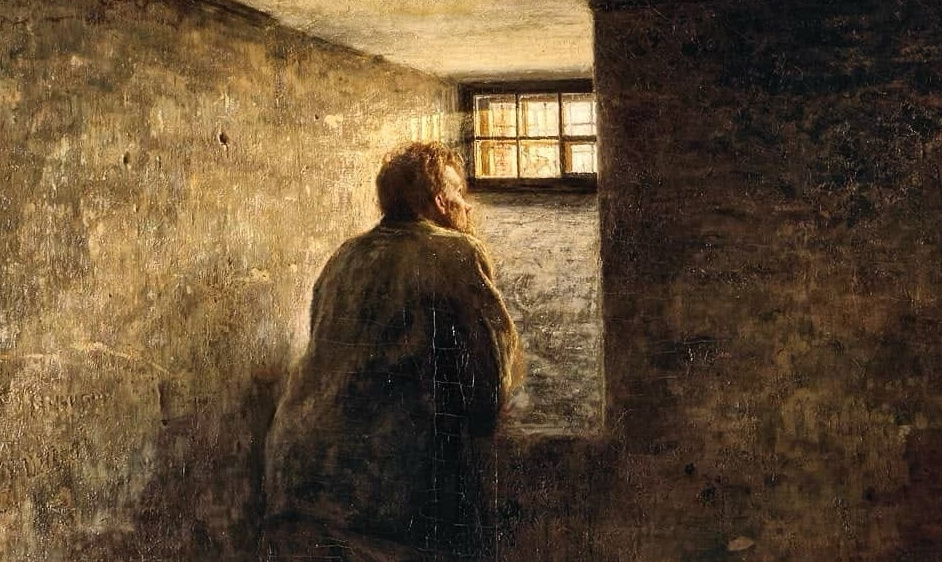
Featured Image: Nikolai Yaroshenko, Prisoner, oil on canvas, 1878.


